
Articles: A Former Muslim’s Grave Warning to America
A Former Muslim’s Grave Warning to America
Islam “has begotten a bloodthirsty ideology that is determined to destroy the principles of liberty and humanity and basic decency,” ex-Muslim and activist Ayaan Hirsi Ali said June 3 at the John F. Kennedy Center in Washington, D.C.
Hirsi Ali knows what she’s talking about. Born in Mogadishu, Somalia, she was raised Muslim. She spent her childhood and young adulthood in Africa and Saudi Arabia. She fled as a refugee to the Netherlands in 1992, where she earned a political science degree and was elected to the Dutch House of Representatives. After the terrorist attacks of Sept. 11, 2001, Hirsi Ali renounced Islam.
Last week she accepted an award from the Milwaukee-based Lynde and Harry Bradley Foundation, which prides itself on “strengthening American democratic capitalism and the institutions, principles and values that sustain and nurture it.”
Some in the conservative movement refer to the annual Bradley Prizes event, which was emceed this year by commentator George Will, as the “conservative Oscars.” The other recipients this year were James W. Ceaser, a political science professor at the University of Virginia; Larry P. Arnn, president of Hillsdale College; and retired Army Gen. Jack Keane, chairman of the Institute for the Study of War.
The late Christopher Hitchens called Hirsi Ali, whose former religion forced female circumcision on her, someone “of arresting and hypnotizing beauty,” and “a charismatic figure” who writes “with quite astonishing humor and restraint.” In 2005, Time magazine named her one of the 100 most influential people in the world.
She famously said, “Islam is not a religion of peace. It’s a political theory of conquest that seeks domination by any means it can.”
Her latest book, Heretic: Why Islam Needs a Reformation Now, was published in March by Harper. (It was reviewed by Katherine Ernst in City Journal.)
“My argument is that it is foolish to insist, as our leaders habitually do, that the violent acts of radical Islamists can be divorced from the religious ideals that inspire them,” she writes in Heretic. She continues:
Instead we must acknowledge that they are driven by a political ideology, an ideology embedded in Islam itself, in the holy book of the Qur’an as well as the life and teachings of the Prophet Muhammad contained in the hadith.
Let me make my point in the simplest possible terms: Islam is not a religion of peace.
For expressing the idea that Islamic violence is rooted not in social, economic, or political conditions – or even in theological error – but rather in the foundational texts of Islam itself, I have been denounced as a bigot and an “Islamophobe.” I have been silenced, shunned, and shamed. In effect, I have been deemed to be a heretic, not just by Muslims – for whom I am already an apostate – but by some Western liberals as well, whose multicultural sensibilities are offended by such “insensitive” pronouncements … today, it seems, speaking the truth about Islam is a crime. “Hate speech” is the modern term for heresy. And in the present atmosphere, anything that makes Muslims feel uncomfortable is branded as “hate.”
In the book, Hirsi Ali writes that it is her goal “to make many people – not only Muslims but also Western apologists for Islam – uncomfortable” by “challenging centuries of religious orthodoxy with ideas and arguments that I am certain will be denounced as heretical.”
“My argument is for nothing less than a Muslim Reformation,” she writes. “Without fundamental alterations to some of Islam’s core concepts, I believe, we shall not solve the burning and increasingly global problem of political violence carried out in the name of religion.”
In her remarks at the Kennedy Center, Hirsi Ali summarized what brought her to this point and what needs to be done. With the exception of the opening pleasantries, here follows a transcript of this brave woman’s speech:
Ladies and gentlemen, the Bradley Foundation is committed to strengthening American democratic capitalism and the institutions, principles, and values that sustain and nurture it. It supports limited, competent government, a dynamic marketplace for economic, intellectual, and cultural activity and a vigorous defense at home and abroad of American ideas and institutions.
It may same strange to you that I, an immigrant black woman from a Muslim family, should identify so strongly with those goals. Let me explain to you why I do. There are three reasons.
First, it’s because my life’s journey which has taken me from Somalia to Saudi Arabia to Ethiopia to Kenya to the Netherlands and finally here, could not have been better designed to make me appreciate American principles and American institutions.
Second, I think I can justly say that I was among the first in my age group of millions of Muslims to admit that our faith, no longer mine, has begotten a bloodthirsty ideology that is determined to destroy the principles of liberty and humanity and basic decency.
Even after 9/11 there are still those who naively believe that it’s a threat only in countries like Syria, Iraq, and Afghanistan. The reality as our general [i.e. Jack Keane] just laid out, is that it is now a global threat. A recent report by the United Nations Security Council confirmed that more than 100 countries are now supplying recruits to the Islamic State and al-Qaeda, and the United States is one of them.
This year alone the number of U.S.-based individuals in Islamic terror-related cases has risen to 40. What concerns me is not jihad, or it’s not only jihad. It’s also the nonviolent activities from preaching to fundraising that are its essential seedbed. Often those who engage in these activities are very skillful at representing themselves as moderates.
Let me quote you the words of Abdurahman Alamoudi, a founder of the American Muslim Council, who at one time was an Islamic advisor to President Clinton and a goodwill ambassador to the State Department, as well as being consulted by some eminent Republicans.
“We have a chance,” he declared to a Muslim audience, “to be the moral leadership of America. It will happen, it will happen praise Allah the Exalted. I have no doubt in my mind. It depends on me and you, either we do it now or we do it after a hundred years, but this country will become a Muslim country.”
That is the authentic voice of a plot against America today. I am glad to report that Alamoudi is currently serving a 23-year prison sentence for financial and conspiracy offenses involving the Libyan government and the al-Qaeda plot to assassinate the then-crown prince of Saudi Arabia.
Third, and finally, I have come to see that there is a creative threat close to American institutions, the ones opposed by those within the West who appease the Islamic extremists.
Last September our president insisted the Islamic State is not Islamic. Later that month he told the U.N. General Assembly that Islam teaches peace. Phrases like “radical Islam” and “Islamic extremism” are no longer heard in the White House press conferences.
The approved term is “violent extremism.” Ladies and gentlemen, if we don’t define the problem, if we can’t bring ourselves to define the problem, then how on earth can we ever hope to solve it? [audience applauds]
The decision not to call violence committed in the name of Islam by its true name is a very strange one. Imagine if Western leaders during the Cold War had gone around calling Communism an ideology of peace or condemning the Baader-Meinhof Gang for not being true Marxists.
Ladies and gentlemen, I believe it is time to drop the euphemisms and verbal contortions. As I argue in my most recent book, Heretic, a battle for the future of Islam is taking place between reformers and reactionaries, between dissidents and jihadists, with the majority of Muslims caught in the middle unsure which side to take. The outcome matters, matters to Muslims but it matters to us and to global peace, and the United States needs to start helping the right side to win.
Sometimes people who want to smear me use the sham term, “Islamophobe,” which is designed to imply that those who scrutinize Islamic extremism are bigots. Well, I may have a phobia, but it’s not directed against Muslims. After all I used to be one. My phobia is towards any ideology, whether it is Communism, Fascism, or Islamism, that threatens individual freedom and the institutions that protect those freedoms.
That is why I am so grateful and so proud to accept this honor from you tonight.
Thank you, very, very much.
Hirsi Ali’s personal story bears some resemblance to that of Dutch politician Geert Wilders. Wilders is a member of the Dutch House of Representatives and leader of his country’s Partij voor de Vrijheid (PVV), or in English, the Party for Freedom.
Like Hirsi Ali, he denounces Islam on a regular basis and has had round-the-clock bodyguards protecting him for more than a decade. “It’s really risky to tell the truth about Islam,” he said on a visit to the U.S. earlier this year.
“If you do so, first you end up on a jihadi death list as happened to me and many others,” Wilders said.
“Not only the Pakistani Taliban and ISIS want me killed but I’m on a death list from al-Qaeda with several columnists, authors, and journalists some of which already paid with their lives, others who are already victims of assassination, and others left under permanent police protection.”
“In Europe, however, it’s not just the jihadists who will go after you,” he said. “The authorities do so too.” Wilders has been taken to court in his home country for speaking the truth about Islam. He was acquitted, but the authorities still want his head.
“Unfortunately most Western leaders are weak,” he said. “They hope that if they ignore the threat, the threat will simply disappear, but it will not. It will only get worse.”
Hirsi Ali got the attention of terrorists when she wrote the script for a short film called Submission that threw light on the harsh treatment of women in Islamic societies.
The director of the movie, Theo van Gogh, was murdered in Amsterdam in 2004 and almost decapitated by terrorist Mohammed Bouyeri, who subsequently received a sentence of life imprisonment without the possibility of parole for his crime. Bouyeri drove a knife into his victim’s chest in order to leave a note warning Hirsi Ali that she and others who criticize Islam would be next.
Just two years earlier, another prominent Dutchman, Pim Fortuyn, was murdered by Volkert van der Graaf, a pro-Islam activist who said in court that he killed the politician to stop him from exploiting Muslims as “scapegoats.” Fortuyn was described by the Daily Telegraph as “a gay former Marxist professor who mixed Left-wing and Right-wing ideas.”
In an interview shortly before he was assassinated, Fortuyn said Muslim immigrants “don’t share with us the core values of modernity and think quite differently about relationships between women and men and individual responsibility.” Foreshadowing his own death, Fortuyn added, “Freedom of speech is very important and their treatment of sexual minorities like gay men and women is a big problem.”
Here in America, some people trying to draw attention to the Muslim menace were rewarded last month with a two-man assault that ended in the terrorists’ death.
The attack took place May 3 near Dallas, Texas, outside the “Muhammad Art Exhibit and Cartoon Contest,” a sold-out event organized by Pamela Geller’s American Freedom Defense Initiative (AFDI). Although it wasn’t always this way, Muslims do not tolerate any artistic depictions of their prophet, whether drawn, painted, sculpted, filmed, or in any other medium.
Four months before that, self-identified members of al-Qaeda in the Arabian Peninsula broke into the Paris offices of the satirical magazine Charlie Hebdo, slaughtering 11 people in a hail of gunfire. The publication’s offense was to print images of Muhammad.
Unless Islam undergoes the great reformation Ayaan Hirsi Ali urges, these Islamic terrorist atrocities will never cease.
Matthew Vadum (personal website) is a senior editor at Capital Research Center in Washington, D.C. as well as an investigative journalist. Vadum is author of the ACORN/Obama exposé Subversion Inc.: How Obama’s ACORN Red Shirts are Still Terrorizing and Ripping Off American Taxpayers. Follow him on Twitter. E-mail him at matthewvadum [at] gmail.com.
Islam “has begotten a bloodthirsty ideology that is determined to destroy the principles of liberty and humanity and basic decency,” ex-Muslim and activist Ayaan Hirsi Ali said June 3 at the John F. Kennedy Center in Washington, D.C.
Hirsi Ali knows what she’s talking about. Born in Mogadishu, Somalia, she was raised Muslim. She spent her childhood and young adulthood in Africa and Saudi Arabia. She fled as a refugee to the Netherlands in 1992, where she earned a political science degree and was elected to the Dutch House of Representatives. After the terrorist attacks of Sept. 11, 2001, Hirsi Ali renounced Islam.
Last week she accepted an award from the Milwaukee-based Lynde and Harry Bradley Foundation, which prides itself on “strengthening American democratic capitalism and the institutions, principles and values that sustain and nurture it.”
Some in the conservative movement refer to the annual Bradley Prizes event, which was emceed this year by commentator George Will, as the “conservative Oscars.” The other recipients this year were James W. Ceaser, a political science professor at the University of Virginia; Larry P. Arnn, president of Hillsdale College; and retired Army Gen. Jack Keane, chairman of the Institute for the Study of War.
The late Christopher Hitchens called Hirsi Ali, whose former religion forced female circumcision on her, someone “of arresting and hypnotizing beauty,” and “a charismatic figure” who writes “with quite astonishing humor and restraint.” In 2005, Time magazine named her one of the 100 most influential people in the world.
She famously said, “Islam is not a religion of peace. It’s a political theory of conquest that seeks domination by any means it can.”
Her latest book, Heretic: Why Islam Needs a Reformation Now, was published in March by Harper. (It was reviewed by Katherine Ernst in City Journal.)
“My argument is that it is foolish to insist, as our leaders habitually do, that the violent acts of radical Islamists can be divorced from the religious ideals that inspire them,” she writes in Heretic. She continues:
Instead we must acknowledge that they are driven by a political ideology, an ideology embedded in Islam itself, in the holy book of the Qur’an as well as the life and teachings of the Prophet Muhammad contained in the hadith.
Let me make my point in the simplest possible terms: Islam is not a religion of peace.
For expressing the idea that Islamic violence is rooted not in social, economic, or political conditions – or even in theological error – but rather in the foundational texts of Islam itself, I have been denounced as a bigot and an “Islamophobe.” I have been silenced, shunned, and shamed. In effect, I have been deemed to be a heretic, not just by Muslims – for whom I am already an apostate – but by some Western liberals as well, whose multicultural sensibilities are offended by such “insensitive” pronouncements … today, it seems, speaking the truth about Islam is a crime. “Hate speech” is the modern term for heresy. And in the present atmosphere, anything that makes Muslims feel uncomfortable is branded as “hate.”
In the book, Hirsi Ali writes that it is her goal “to make many people – not only Muslims but also Western apologists for Islam – uncomfortable” by “challenging centuries of religious orthodoxy with ideas and arguments that I am certain will be denounced as heretical.”
“My argument is for nothing less than a Muslim Reformation,” she writes. “Without fundamental alterations to some of Islam’s core concepts, I believe, we shall not solve the burning and increasingly global problem of political violence carried out in the name of religion.”
In her remarks at the Kennedy Center, Hirsi Ali summarized what brought her to this point and what needs to be done. With the exception of the opening pleasantries, here follows a transcript of this brave woman’s speech:
Ladies and gentlemen, the Bradley Foundation is committed to strengthening American democratic capitalism and the institutions, principles, and values that sustain and nurture it. It supports limited, competent government, a dynamic marketplace for economic, intellectual, and cultural activity and a vigorous defense at home and abroad of American ideas and institutions.
It may same strange to you that I, an immigrant black woman from a Muslim family, should identify so strongly with those goals. Let me explain to you why I do. There are three reasons.
First, it’s because my life’s journey which has taken me from Somalia to Saudi Arabia to Ethiopia to Kenya to the Netherlands and finally here, could not have been better designed to make me appreciate American principles and American institutions.
Second, I think I can justly say that I was among the first in my age group of millions of Muslims to admit that our faith, no longer mine, has begotten a bloodthirsty ideology that is determined to destroy the principles of liberty and humanity and basic decency.
Even after 9/11 there are still those who naively believe that it’s a threat only in countries like Syria, Iraq, and Afghanistan. The reality as our general [i.e. Jack Keane] just laid out, is that it is now a global threat. A recent report by the United Nations Security Council confirmed that more than 100 countries are now supplying recruits to the Islamic State and al-Qaeda, and the United States is one of them.
This year alone the number of U.S.-based individuals in Islamic terror-related cases has risen to 40. What concerns me is not jihad, or it’s not only jihad. It’s also the nonviolent activities from preaching to fundraising that are its essential seedbed. Often those who engage in these activities are very skillful at representing themselves as moderates.
Let me quote you the words of Abdurahman Alamoudi, a founder of the American Muslim Council, who at one time was an Islamic advisor to President Clinton and a goodwill ambassador to the State Department, as well as being consulted by some eminent Republicans.
“We have a chance,” he declared to a Muslim audience, “to be the moral leadership of America. It will happen, it will happen praise Allah the Exalted. I have no doubt in my mind. It depends on me and you, either we do it now or we do it after a hundred years, but this country will become a Muslim country.”
That is the authentic voice of a plot against America today. I am glad to report that Alamoudi is currently serving a 23-year prison sentence for financial and conspiracy offenses involving the Libyan government and the al-Qaeda plot to assassinate the then-crown prince of Saudi Arabia.
Third, and finally, I have come to see that there is a creative threat close to American institutions, the ones opposed by those within the West who appease the Islamic extremists.
Last September our president insisted the Islamic State is not Islamic. Later that month he told the U.N. General Assembly that Islam teaches peace. Phrases like “radical Islam” and “Islamic extremism” are no longer heard in the White House press conferences.
The approved term is “violent extremism.” Ladies and gentlemen, if we don’t define the problem, if we can’t bring ourselves to define the problem, then how on earth can we ever hope to solve it? [audience applauds]
The decision not to call violence committed in the name of Islam by its true name is a very strange one. Imagine if Western leaders during the Cold War had gone around calling Communism an ideology of peace or condemning the Baader-Meinhof Gang for not being true Marxists.
Ladies and gentlemen, I believe it is time to drop the euphemisms and verbal contortions. As I argue in my most recent book, Heretic, a battle for the future of Islam is taking place between reformers and reactionaries, between dissidents and jihadists, with the majority of Muslims caught in the middle unsure which side to take. The outcome matters, matters to Muslims but it matters to us and to global peace, and the United States needs to start helping the right side to win.
Sometimes people who want to smear me use the sham term, “Islamophobe,” which is designed to imply that those who scrutinize Islamic extremism are bigots. Well, I may have a phobia, but it’s not directed against Muslims. After all I used to be one. My phobia is towards any ideology, whether it is Communism, Fascism, or Islamism, that threatens individual freedom and the institutions that protect those freedoms.
That is why I am so grateful and so proud to accept this honor from you tonight.
Thank you, very, very much.
Hirsi Ali’s personal story bears some resemblance to that of Dutch politician Geert Wilders. Wilders is a member of the Dutch House of Representatives and leader of his country’s Partij voor de Vrijheid (PVV), or in English, the Party for Freedom.
Like Hirsi Ali, he denounces Islam on a regular basis and has had round-the-clock bodyguards protecting him for more than a decade. “It’s really risky to tell the truth about Islam,” he said on a visit to the U.S. earlier this year.
“If you do so, first you end up on a jihadi death list as happened to me and many others,” Wilders said.
“Not only the Pakistani Taliban and ISIS want me killed but I’m on a death list from al-Qaeda with several columnists, authors, and journalists some of which already paid with their lives, others who are already victims of assassination, and others left under permanent police protection.”
“In Europe, however, it’s not just the jihadists who will go after you,” he said. “The authorities do so too.” Wilders has been taken to court in his home country for speaking the truth about Islam. He was acquitted, but the authorities still want his head.
“Unfortunately most Western leaders are weak,” he said. “They hope that if they ignore the threat, the threat will simply disappear, but it will not. It will only get worse.”
Hirsi Ali got the attention of terrorists when she wrote the script for a short film called Submission that threw light on the harsh treatment of women in Islamic societies.
The director of the movie, Theo van Gogh, was murdered in Amsterdam in 2004 and almost decapitated by terrorist Mohammed Bouyeri, who subsequently received a sentence of life imprisonment without the possibility of parole for his crime. Bouyeri drove a knife into his victim’s chest in order to leave a note warning Hirsi Ali that she and others who criticize Islam would be next.
Just two years earlier, another prominent Dutchman, Pim Fortuyn, was murdered by Volkert van der Graaf, a pro-Islam activist who said in court that he killed the politician to stop him from exploiting Muslims as “scapegoats.” Fortuyn was described by the Daily Telegraph as “a gay former Marxist professor who mixed Left-wing and Right-wing ideas.”
In an interview shortly before he was assassinated, Fortuyn said Muslim immigrants “don’t share with us the core values of modernity and think quite differently about relationships between women and men and individual responsibility.” Foreshadowing his own death, Fortuyn added, “Freedom of speech is very important and their treatment of sexual minorities like gay men and women is a big problem.”
Here in America, some people trying to draw attention to the Muslim menace were rewarded last month with a two-man assault that ended in the terrorists’ death.
The attack took place May 3 near Dallas, Texas, outside the “Muhammad Art Exhibit and Cartoon Contest,” a sold-out event organized by Pamela Geller’s American Freedom Defense Initiative (AFDI). Although it wasn’t always this way, Muslims do not tolerate any artistic depictions of their prophet, whether drawn, painted, sculpted, filmed, or in any other medium.
Four months before that, self-identified members of al-Qaeda in the Arabian Peninsula broke into the Paris offices of the satirical magazine Charlie Hebdo, slaughtering 11 people in a hail of gunfire. The publication’s offense was to print images of Muhammad.
Unless Islam undergoes the great reformation Ayaan Hirsi Ali urges, these Islamic terrorist atrocities will never cease.
Matthew Vadum (personal website) is a senior editor at Capital Research Center in Washington, D.C. as well as an investigative journalist. Vadum is author of the ACORN/Obama exposé Subversion Inc.: How Obama’s ACORN Red Shirts are Still Terrorizing and Ripping Off American Taxpayers. Follow him on Twitter. E-mail him at matthewvadum [at] gmail.com.
Read more: http://www.americanthinker.com/articles/2015/06/a_former_muslims_grave_warning_to_america.html#ixzz3clzJ1RCI
Follow us: @AmericanThinker on Twitter | AmericanThinker on Facebookhttp://www.americanthinker.com/articles/2015/06/a_former_muslims_grave_warning_to_america.html

Articles: Where are Those Moderate Muslims — and How Should We Deal with Them?
Eleven months before 9/11, I heard a series of lectures from a Muslim doctor to a Protestant congregation, in which he contradicted much of what I had learned about the religion’s history and foundation when I had studied it and lived abroad among Muslims two to three decades earlier. For example, he assured the credulous audience that Islam had never been spread by the sword, but rather that was a Western canard. Already extremely concerned about militant Islam, I started reading updated works on the ideology. It didn’t take me long to realize that my prior understanding hadn’t been superseded by new discoveries. At best, the pious doctor was offering a positive spin on Islam; more likely he was actually, deliberately engaging in taqiyya – righteous deception to advance Islam.
With the attacks of 9/11, I began an extensive, deliberate effort to understand the religion and the violence that it was spewing. I read authors across the spectrum of attitudes towards Islam, from the highly sympathetic Karen Armstrong to the implacably critical Ibn Warraq. I also attend the lectures of Islamic scholars such as leading apologist John Esposito (“the antidote to Bernard Lewis,” one liberal minister mockingly assured me), and I interviewed pious Muslims. I then organized my thoughts by writing them down in what eventually became a book. One of the most significant insights I obtained from this process was that there are eight basic principles of Islam that lead to its violent aggression. Exhibit 1 enumerates those tenets.
Each of these principles comes directly from the Qur’an, except the last. They are all virtually universally accepted in Islam, as attested by my interviews with Muslims as well as the writings of western Islamic scholars. These principles impel observant Muslims to struggle to advance Islam to its divinely ordained position of global dominance, and while doing so to unite with other Muslims while holding non-Muslims at arm’s length, at best. At worst (as we have been seeing recently in Syria, Iraq, Libya, and Nigeria), Muslims should force others either to convert to Islam or take one of two other alternatives: if Christians or Jews, to submit to Muslim rule while paying a tax to show their submission; or if they can’t, or are of another or no faith, to die.
Recently a Protestant minister and I led a two man panel discussion of Islam, and when we came to this exhibit, he explained to the audience that these eight tenets makes some Muslims militant. I had to correct him, pointing out that these tenets make Islam militant and that extremists accept them explicitly. That distinction is vital.
Since they impel the faithful to violence, these tenets raise the question: How can believing Muslims do anything other than engage in jihad? Put another way, how can Muslims be moderate? That in turn raises the question, what is a moderate Muslim?
Research for the book uncovered the view, widely held across the sympathy spectrum, that “moderate” Muslims accepted a series of pacifying interpretations of Islam and its scriptures. These interpretations, which had evolved over Islam’s first five centuries, essentially toned down its harsher messages and rubbed off its sharper edges, enabling Muslims to live harmoniously with one another and, particularly since about the 19th Century, more peacefully with non-Muslim neighbors. The difference extremists exhibited was that they took the commands of their scriptures literally and hence acted upon them.
However, seeking to understand which Muslims were moderate and how large a portion of the 1.6 billion global Muslim community, or Ummah, they represented, it is impossible to find hard numbers: The definition of “moderate” is simply too slippery. Is a Muslim living peacefully in rural villages of Morocco or Indonesia, practicing traditional Islam but outraged that a Jewish state took land from Muslims in direct violation of shari’a, moderate? What if he suddenly decided to act on his outrage? What about a Muslim of Pakistani descent living near Nottingham with similar views, at least up until he decided to go to a terrorist training camp? (This is the real story of Kasim Hafeez before he renounced violence.) Are Muslims living in peace on the Arabian Peninsula who donate generously to Hamas — a legitimate Islamic charity in their eyes — moderate? Is a Muslim doing the same thing in Dearborn or a Chicago suburb moderate? Is a Muslim moderate if he engages in non-violent jihad, such as lawfare, in order to make Islam dominant, as practiced by members of the Council on American-Islamic Relations (CAIR) and the Muslim Student Association? Bright lines don’t exist, yet virtually everyone commenting on Islam speaks of “moderate Muslims.” Few, however, define them.
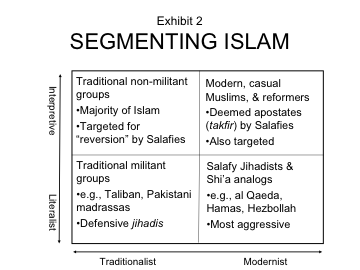
In presentations on radical Islam, one of the conceptual devices I have employed that helps people think about the ideological differences between Muslims is Exhibit 2.
The vertical axis refers to whether Muslims read their sacred texts interpretively, as has been the practice of most Muslims for about 1,000 years, or strictly literally as the Wahhabis, Muslim Brotherhood and their various ideological offspring, including al Qaeda, ISIS, and the Iranian Shi’a Islamists, insist. The horizontal axis measures how traditional a Muslim is in his attitude towards and practice of Islam, versus how modernized he is, in one of two ways. “Modernized” can mean adapted to modernity, but it can also mean incorporating into Islam elements of 20th Century authoritarian ideologies such as communism and fascism, again as directed by the Muslim Brotherhood.
The two dimensions are of course continua and there are no hard and fast boundaries. In addition, one might add a third dimension, the intensity of belief. That is probably most relevant in the upper left quadrant of traditional non-militants, where intense piety might make Muslims more likely to become militant and move downward or even to the lower right. It is possible that among modernist literalist jihadis in the lower left there are some cynical opportunists who couldn’t care less about the spiritual aspects of Islam but are selfishly attracted to the jihad by the opportunity for power and booty. However, such inwardly secular extremists probably represent a small portion of such militants and may be marginalized or even culled out by the true believers.
While the quadrants have equal areas, they most definitely do not represent equal proportions of the Ummah. The upper left quadrant contains the vast majority of Muslims. That would include Muslims not just in traditional Islamic societies from the Maghreb through South Asia and into Indonesia, but also in sequestered Muslim communities in the West. When Muslims from that quadrant become radicalized by the Muslim Brotherhood and its offshoots, or to drive out infidel Russians or Americans, they descend, at least initially, into the lower left quadrant. Some might then move to the lower right.
Those in the lower right are the highly radicalized, militant Muslims that are most aggressively pursuing the Third Jihad. Some, such as Abu Bakr al-Baghdadi, the self-proclaimed Khalifa Ibrahim, come from traditional, pious, even scholarly Islamic backgrounds, and have apparently imbibed inebriating amounts of the Muslim Brotherhood’s radicalizing ideology. However, it appears that most of the older leaders came from more modern, even Western backgrounds, perhaps even indifferent to Islam early in life. When these people first became serious about Islam, they read it literally, often with the guidance of other radicalized Muslims, and hence adopted its purest, harshest meanings. Radicals of this sort include Osama bin Laden, Dr. Ayman al-Zawahiri, Mohammed Atta, and Major Nidal Hassan, among many others. Dr. Daniel Pipes recognized this phenomenon 20 years ago, and has since commented on it frequently. Many others have noted it as well. Increasingly, we are seeing young Muslims who have been deliberately radicalized by their elders, whether in Islamic countries, at radical mosques in the West, or simply online, including the Boston bombing brothers, Tamerlan and Dzhokhar Tsarnaev.
We haven’t yet addressed one quadrant, the upper right. This holds the still practicing but interpretive, open-minded, modernized, often Westernized Muslims, whether they live in Chicago or Cairo, London or Lahore. Widely recognized examples are Fareed Zakariah, King Abdullah and especially Queen Noor of Jordan; lesser known but still prominent ones include Tarek Fatah, Irshad Manji, Dr. Qanta Ahmed, andDr. Zuhdi Jasser. Some, such as Dr. Jasser, take the unusual position that the Qur’anic commands to violence and aggression were meant for 7th Century Arabia, not the 21st Century world, but most appear to have a more conventional view of the scriptures and simply interpret them more peacefully or choose to ignore the more violent commands. They may be the Muslim equivalents of cafeteria Catholics. Muslims in this quadrant are the ones most Westerners encounter in their daily lives as neighbors, friends, and coworkers. Importantly, the population in this quadrant is probably quite small, but may seem representative to the typical Western, non-Muslim observer because they are the types of Muslims most Westerners encounter. Whether there are more of them than the extremists in the lower right is debatable, but they probably have less influence on Islam overall because of the threats they face for speaking out.
So which are the elusive moderates? While most Westerners would view those in the upper right as moderate, most pious, practicing Muslims would probably consider them liberals. Indeed, the extremists in the lower right view those in the quadrant above not as Muslims at all, but as apostates whom they declare takfir (excommunicated) and target for “reversion” to the true Islam, or extermination. It is no wonder that so many modernized Muslims keep their heads down and their mouths shut about militant Islam.
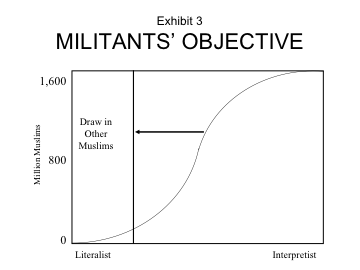
The inescapable conclusion is that the moderates to whom so many non-Muslims look to for support against the radicals are primarily traditional interpretists in the upper left. They have not yet become comfortable with the West and perhaps not even to modernity. Given the demographics of Islamic countries, they are largely young and low income, with limited educations, and high rates of illiteracy. They are not the natural allies of the West. While they are not radicalized and motivated to join the jihad, the radicals are explicitly trying to ignite that motivation. Presuming a normal distribution of Muslims along the literalist/interpretist dimension, if the radicals are successful, then the rate at which the Muslim population would join them would rapidly accelerate, as depicted in Exhibit 3.
An important question to consider is what happens to traditional interpretist Muslims when they and Islam are pressured by outside forces. Evidence over the past thirty-five years from Afghanistan, Iraq, and Syria indicates that many will become radicalized and violent in defense of Islam. This is a direct expression of pillars #3 and 5 from Exhibit 1; they become impelled to defend Islam, in the “hivish” behavior of bees rallying to defend their hive, to use a term coined by noted psychologist Jonathan Haidt.
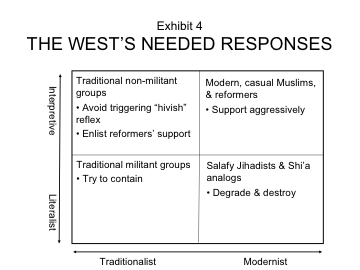
If we use the matrix in Exhibit 2 to suggest how the West should handle the different categories of Muslims, it is clear that those in each quadrant demand a different approach. These are summarized in Exhibit 4.
The West cannot idly hope that the traditionalist, non-militant Muslims will work to eliminate the radicals. The literalist radicals have the words of their scriptures, including the purported words of Allah in the Qur’an, on their side. Instead, we in the West have to do our best not to trigger, or at least to counter, their “hivish” reflex to rally to the aid of the radicals whom the West must degrade and destroy, and to enlist the support of reformers to keep these traditionalists out of the fight. Conversely, the West must aggressively combat the violent radicals and also expose and neutralize those affiliates of the Muslim Brotherhood and the Iranian regime who are active in the West and pretend to be peaceful, such as CAIR.
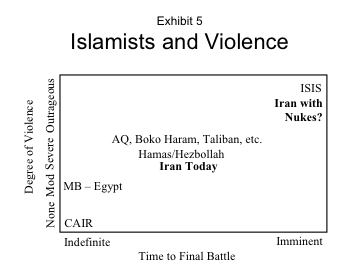
Unfortunately, it has become evident that as radical militant groups come to believe that they are close to precipitating the end time of their eschatology, they become outrageously violent, as Graeme Wood recently described and upon which I elaborated. Exhibit 5 lays out the pattern that emerges from arraying various prominent Islamic groups along one dimension that describes how imminent they believe Islam’s end time is (and hence how able they might be to precipitate them) versus how peaceful or violent they have become.
If this perspective has any predictive value, then the world will have hell to pay if the Obama Administration enables Iran to develop a nuclear arsenal. At that point, provoking the hivish reflex among moderate Muslims may become inevitable. So stopping Iran from developing nuclear weapons should be the lynchpin of any strategy to deal with Islamic militancy, followed by defeating the militants while cooperating with the liberals to contain the moderates.
Eleven months before 9/11, I heard a series of lectures from a Muslim doctor to a Protestant congregation, in which he contradicted much of what I had learned about the religion’s history and foundation when I had studied it and lived abroad among Muslims two to three decades earlier. For example, he assured the credulous audience that Islam had never been spread by the sword, but rather that was a Western canard. Already extremely concerned about militant Islam, I started reading updated works on the ideology. It didn’t take me long to realize that my prior understanding hadn’t been superseded by new discoveries. At best, the pious doctor was offering a positive spin on Islam; more likely he was actually, deliberately engaging in taqiyya – righteous deception to advance Islam.
With the attacks of 9/11, I began an extensive, deliberate effort to understand the religion and the violence that it was spewing. I read authors across the spectrum of attitudes towards Islam, from the highly sympathetic Karen Armstrong to the implacably critical Ibn Warraq. I also attend the lectures of Islamic scholars such as leading apologist John Esposito (“the antidote to Bernard Lewis,” one liberal minister mockingly assured me), and I interviewed pious Muslims. I then organized my thoughts by writing them down in what eventually became a book. One of the most significant insights I obtained from this process was that there are eight basic principles of Islam that lead to its violent aggression. Exhibit 1 enumerates those tenets.
Each of these principles comes directly from the Qur’an, except the last. They are all virtually universally accepted in Islam, as attested by my interviews with Muslims as well as the writings of western Islamic scholars. These principles impel observant Muslims to struggle to advance Islam to its divinely ordained position of global dominance, and while doing so to unite with other Muslims while holding non-Muslims at arm’s length, at best. At worst (as we have been seeing recently in Syria, Iraq, Libya, and Nigeria), Muslims should force others either to convert to Islam or take one of two other alternatives: if Christians or Jews, to submit to Muslim rule while paying a tax to show their submission; or if they can’t, or are of another or no faith, to die.
Recently a Protestant minister and I led a two man panel discussion of Islam, and when we came to this exhibit, he explained to the audience that these eight tenets makes some Muslims militant. I had to correct him, pointing out that these tenets make Islam militant and that extremists accept them explicitly. That distinction is vital.
Since they impel the faithful to violence, these tenets raise the question: How can believing Muslims do anything other than engage in jihad? Put another way, how can Muslims be moderate? That in turn raises the question, what is a moderate Muslim?
Research for the book uncovered the view, widely held across the sympathy spectrum, that “moderate” Muslims accepted a series of pacifying interpretations of Islam and its scriptures. These interpretations, which had evolved over Islam’s first five centuries, essentially toned down its harsher messages and rubbed off its sharper edges, enabling Muslims to live harmoniously with one another and, particularly since about the 19th Century, more peacefully with non-Muslim neighbors. The difference extremists exhibited was that they took the commands of their scriptures literally and hence acted upon them.
However, seeking to understand which Muslims were moderate and how large a portion of the 1.6 billion global Muslim community, or Ummah, they represented, it is impossible to find hard numbers: The definition of “moderate” is simply too slippery. Is a Muslim living peacefully in rural villages of Morocco or Indonesia, practicing traditional Islam but outraged that a Jewish state took land from Muslims in direct violation of shari’a, moderate? What if he suddenly decided to act on his outrage? What about a Muslim of Pakistani descent living near Nottingham with similar views, at least up until he decided to go to a terrorist training camp? (This is the real story of Kasim Hafeez before he renounced violence.) Are Muslims living in peace on the Arabian Peninsula who donate generously to Hamas — a legitimate Islamic charity in their eyes — moderate? Is a Muslim doing the same thing in Dearborn or a Chicago suburb moderate? Is a Muslim moderate if he engages in non-violent jihad, such as lawfare, in order to make Islam dominant, as practiced by members of the Council on American-Islamic Relations (CAIR) and the Muslim Student Association? Bright lines don’t exist, yet virtually everyone commenting on Islam speaks of “moderate Muslims.” Few, however, define them.
In presentations on radical Islam, one of the conceptual devices I have employed that helps people think about the ideological differences between Muslims is Exhibit 2.
The vertical axis refers to whether Muslims read their sacred texts interpretively, as has been the practice of most Muslims for about 1,000 years, or strictly literally as the Wahhabis, Muslim Brotherhood and their various ideological offspring, including al Qaeda, ISIS, and the Iranian Shi’a Islamists, insist. The horizontal axis measures how traditional a Muslim is in his attitude towards and practice of Islam, versus how modernized he is, in one of two ways. “Modernized” can mean adapted to modernity, but it can also mean incorporating into Islam elements of 20th Century authoritarian ideologies such as communism and fascism, again as directed by the Muslim Brotherhood.
The two dimensions are of course continua and there are no hard and fast boundaries. In addition, one might add a third dimension, the intensity of belief. That is probably most relevant in the upper left quadrant of traditional non-militants, where intense piety might make Muslims more likely to become militant and move downward or even to the lower right. It is possible that among modernist literalist jihadis in the lower left there are some cynical opportunists who couldn’t care less about the spiritual aspects of Islam but are selfishly attracted to the jihad by the opportunity for power and booty. However, such inwardly secular extremists probably represent a small portion of such militants and may be marginalized or even culled out by the true believers.
While the quadrants have equal areas, they most definitely do not represent equal proportions of the Ummah. The upper left quadrant contains the vast majority of Muslims. That would include Muslims not just in traditional Islamic societies from the Maghreb through South Asia and into Indonesia, but also in sequestered Muslim communities in the West. When Muslims from that quadrant become radicalized by the Muslim Brotherhood and its offshoots, or to drive out infidel Russians or Americans, they descend, at least initially, into the lower left quadrant. Some might then move to the lower right.
Those in the lower right are the highly radicalized, militant Muslims that are most aggressively pursuing the Third Jihad. Some, such as Abu Bakr al-Baghdadi, the self-proclaimed Khalifa Ibrahim, come from traditional, pious, even scholarly Islamic backgrounds, and have apparently imbibed inebriating amounts of the Muslim Brotherhood’s radicalizing ideology. However, it appears that most of the older leaders came from more modern, even Western backgrounds, perhaps even indifferent to Islam early in life. When these people first became serious about Islam, they read it literally, often with the guidance of other radicalized Muslims, and hence adopted its purest, harshest meanings. Radicals of this sort include Osama bin Laden, Dr. Ayman al-Zawahiri, Mohammed Atta, and Major Nidal Hassan, among many others. Dr. Daniel Pipes recognized this phenomenon 20 years ago, and has since commented on it frequently. Many others have noted it as well. Increasingly, we are seeing young Muslims who have been deliberately radicalized by their elders, whether in Islamic countries, at radical mosques in the West, or simply online, including the Boston bombing brothers, Tamerlan and Dzhokhar Tsarnaev.
We haven’t yet addressed one quadrant, the upper right. This holds the still practicing but interpretive, open-minded, modernized, often Westernized Muslims, whether they live in Chicago or Cairo, London or Lahore. Widely recognized examples are Fareed Zakariah, King Abdullah and especially Queen Noor of Jordan; lesser known but still prominent ones include Tarek Fatah, Irshad Manji, Dr. Qanta Ahmed, andDr. Zuhdi Jasser. Some, such as Dr. Jasser, take the unusual position that the Qur’anic commands to violence and aggression were meant for 7th Century Arabia, not the 21st Century world, but most appear to have a more conventional view of the scriptures and simply interpret them more peacefully or choose to ignore the more violent commands. They may be the Muslim equivalents of cafeteria Catholics. Muslims in this quadrant are the ones most Westerners encounter in their daily lives as neighbors, friends, and coworkers. Importantly, the population in this quadrant is probably quite small, but may seem representative to the typical Western, non-Muslim observer because they are the types of Muslims most Westerners encounter. Whether there are more of them than the extremists in the lower right is debatable, but they probably have less influence on Islam overall because of the threats they face for speaking out.
So which are the elusive moderates? While most Westerners would view those in the upper right as moderate, most pious, practicing Muslims would probably consider them liberals. Indeed, the extremists in the lower right view those in the quadrant above not as Muslims at all, but as apostates whom they declare takfir (excommunicated) and target for “reversion” to the true Islam, or extermination. It is no wonder that so many modernized Muslims keep their heads down and their mouths shut about militant Islam.
The inescapable conclusion is that the moderates to whom so many non-Muslims look to for support against the radicals are primarily traditional interpretists in the upper left. They have not yet become comfortable with the West and perhaps not even to modernity. Given the demographics of Islamic countries, they are largely young and low income, with limited educations, and high rates of illiteracy. They are not the natural allies of the West. While they are not radicalized and motivated to join the jihad, the radicals are explicitly trying to ignite that motivation. Presuming a normal distribution of Muslims along the literalist/interpretist dimension, if the radicals are successful, then the rate at which the Muslim population would join them would rapidly accelerate, as depicted in Exhibit 3.
An important question to consider is what happens to traditional interpretist Muslims when they and Islam are pressured by outside forces. Evidence over the past thirty-five years from Afghanistan, Iraq, and Syria indicates that many will become radicalized and violent in defense of Islam. This is a direct expression of pillars #3 and 5 from Exhibit 1; they become impelled to defend Islam, in the “hivish” behavior of bees rallying to defend their hive, to use a term coined by noted psychologist Jonathan Haidt.
If we use the matrix in Exhibit 2 to suggest how the West should handle the different categories of Muslims, it is clear that those in each quadrant demand a different approach. These are summarized in Exhibit 4.
The West cannot idly hope that the traditionalist, non-militant Muslims will work to eliminate the radicals. The literalist radicals have the words of their scriptures, including the purported words of Allah in the Qur’an, on their side. Instead, we in the West have to do our best not to trigger, or at least to counter, their “hivish” reflex to rally to the aid of the radicals whom the West must degrade and destroy, and to enlist the support of reformers to keep these traditionalists out of the fight. Conversely, the West must aggressively combat the violent radicals and also expose and neutralize those affiliates of the Muslim Brotherhood and the Iranian regime who are active in the West and pretend to be peaceful, such as CAIR.
Unfortunately, it has become evident that as radical militant groups come to believe that they are close to precipitating the end time of their eschatology, they become outrageously violent, as Graeme Wood recently described and upon which I elaborated. Exhibit 5 lays out the pattern that emerges from arraying various prominent Islamic groups along one dimension that describes how imminent they believe Islam’s end time is (and hence how able they might be to precipitate them) versus how peaceful or violent they have become.
If this perspective has any predictive value, then the world will have hell to pay if the Obama Administration enables Iran to develop a nuclear arsenal. At that point, provoking the hivish reflex among moderate Muslims may become inevitable. So stopping Iran from developing nuclear weapons should be the lynchpin of any strategy to deal with Islamic militancy, followed by defeating the militants while cooperating with the liberals to contain the moderates
Read more: http://www.americanthinker.com/articles/2015/06/where_are_those_moderate_muslims__and_how_should_we_deal_with_them.html#ixzz3cZsk3Vzw
Follow us: @AmericanThinker on Twitter | AmericanThinker on Facebook
ISIS fighter ‘follows Jesus after encounter in dream’

WASHINGTON – An ISIS fighter who reveled in killing Christians now follows Jesus Christ after a “man in white” repeatedly appeared to him in dreams and said, “You are killing my people,” according to a missionary leader.
A worker with the international evangelical group Youth With a Mission, or YWAM, came in contact earlier this year with the ISIS fighter, who, though understandably guarded, confided that he had become a Christian.
He confessed he once had “actually enjoyed” killing Christians, according to Gina Fadely, international director of frontier missions for YWAM.
Fadely revealed the story in an interview May 29 on The Voice of the Martyrs Radio Network, the Christian Post reported.
The ISIS fighter, she said, “told this YWAM leader that he had begun having dreams of this man in white who came to him and said, ‘You are killing my people.”
“And he started to feel really sick and uneasy about what he was doing,” Fadely said.
“The fighter said that just before he killed one Christian, the man said, ‘I know you will kill me, but I give to you my Bible.’” Fadely recounted. “The Christian was killed and this ISIS fighter actually took the Bible and began to read it.”
The free WND special report “ISIS Rising,” by Middle East expert and former Department of Defense analyst Michael Maloof, will answer your questions about the jihadist army threatening the West.
She said that in another dream, Jesus asked the ISIS fighter to follow him, and the ISIS fighter “was now asking to become a follower of Christ and to be discipled.”
Fadely recalled the story in the biblical book of Acts of Saul of Tarsus, a persecutor of Christians who had a dramatic encounter with the risen Christ on the road to Damascus and became known as the Apostle Paul.
“So, who knows? Perhaps this man will be like Saul in the Bible,” she said.
In an interview with WND, VOM spokesman Todd Nettleton, who conducted the radio interview, said that what makes the development “so rare is that this ISIS fighter reached out to another Christian and shared his story.”
“I believe there are secret Christians within ISIS,” Nettleton said. “Maybe the Christians they are persecuting had a chance to share with them. There are secret Christians within ISIS.”
Kevin Sutter, a YWAM director who joined Fadley in the radio interview, said an Arab leader had told him that there is a “spiritual hunger” that is “unprecedented” among Muslims.
“Many people are now following Jesus, but they keep it quiet,” Sutter said. “They haven’t gone public about it.”
He said many “even have church in their own home” and will “serve communion to one another as they’re watching TV.”
Convert, be taxed or die
ISIS has declared the creation of a caliphate in portions of Syria and Iraq, and garnered pledges of allegiance from Sunni jihadists across North Africa and in other parts of the world.
ISIS fighters have targeted anyone who does not embrace the militant Sunni Wahhabi form of Islam that originated 200 years ago in Saudi Arabia, which secretly continues to help finance ISIS.
ISIS kills all Shiite Muslims in territory it conquers as well as other ethnic minorities such as the Yazidis, whose women and children are being sold into slavery.
ISIS generally does give Christians the choice of converting to Sunni Islam, paying a tax called a jizya or being killed.
ISIS also is known to have killed other Sunni Muslims whom its fighters believe are not devout enough.
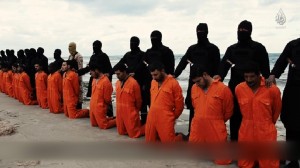
In February, ISIS beheaded 21 Coptic Christians in Libya and then in April released a propaganda video showing the beheadings of 30 Egyptian Christians, all of whom opted not to convert or pay the tax.
And now, a U.S. defense official has confirmed ISIS fighters have captured 88 Eritrean Christian refugees in Libya. A spokesman for an Eritrean refugee group said the ISIS jihadists stopped the truck and demanded the Muslims on board identify themselves. Those who claimed adherence to Islam were then asked questions about the Quran.
Nettleton said Christians should not “write off” ISIS fighters “as being out of reach of God’s grace and out of reach of God’s spirit.”
In the case of the unidentified ISIS fighter, Nettleton said he “reached out, thereby potentially blowing his cover and getting himself killed.”
“He would be told return (to Islam) or be killed,” Nettleton said. “The fact he reached out shows a great deal of courage.”
ISIS generally, however, has not accepted such repentance and has been known to kill those who may have sought to return to Islam, believing they are not faithful enough.
Muslims refer to such conversions as apostasy, which they see as a conscious abandonment of Islamic law, or Shariah, in word and deed.
Apostasy
Notable instances of “apostasy” include Rifqa Bary who in 2009 ran away from her Muslim family in Ohio, saying that they had threatened to kill her for converting to Christianity.
Today, she lives in Ohio and has written a book about her ordeal called “Hiding in the Light.”
Bary, a native of Sri Lanka, said that God’s love touched her “in such a way where I had to give myself and I couldn’t hold back and I had to leave.”
She said that when her family moved to Ohio, she was still a Muslim, but when she was introduced to Christianity, she said she found herself drawn to it because she was able to worship God in a more personal way, not by force, and in a language she was able to understand,” she told Fox News.
“When I was 13, I sought another way and did the really ‘despicable’ thing, which was praying to another God,” she said. “I was desperate just to be able to be free to worship Jesus, so I would sneak out sometimes to go to prayer meetings or I would stay up late and read the Bible in the bathroom or find any possible way.”
After her parents found out about her conversion, Bary said she feared for her life and decided to run away.
“I believe I would have been harmed, if not something more,” she said. “I can’t say. It wasn’t just one decision where I decided to leave. It was an entire life of oppression.”
In another instance, the Telegraph of London reported a woman who used the pseudonym Sofia Allam left the Muslim faith for Christianity and was threatened with death by her father.
Her father declared she had brought shame and humiliation on the family and was “worse than the muck on their shoes.”
Sofia said her father “couldn’t have me in the house now that I was a Kaffir (insulting term for non-Muslim).”
“He said I was damned forever. He insulted me horribly,” she said. “I couldn’t recognize that man as the father who had been so kind to me as I was growing up.”
She said her mother’s transformation was even worse.
“She constantly beat me about the head. She screamed at me all the time. I remember saying to them, as they were shouting death threats, ‘Mum, Dad – you’re saying you should kill me, but I’m your daughter. Don’t you realize that?’




Rapture – Life, Hope & Truth
Rapture: Will There Be a Secret Rapture?
by Don Henson
Many believe when Jesus returns, He will approach secretly to snatch away all believers and children in a rapture to protect them. Is this biblical?
Many Christians believe that when Jesus Christ returns to this earth, He will approach secretly to snatch away all believers and all children in a rapture. The theory is that they will be taken to heaven where they will be protected during the Great Tribulation.
Though the Bible does clearly teach that there will be a Great Tribulation and that Jesus Christ will return, it does not teach there will be a secret rapture.
The rapture theory
This teaching is often referred to as the “rapture theory.” It is a theory because it has no definitive proof. Neither Jesus nor the apostles taught that such an event will occur and, in fact, it has no scriptural support. Although there is some disagreement as to its exact origin, the doctrine was unheard of until the early 19th century and became widespread when it was incorporated into the footnotes of the Scofield Reference Bible.
Scofield’s comments are in reference to 1 Thessalonians 4:17: “Then we who are alive and remain shall be caught up together with them in the clouds to meet the Lord in the air. And thus we shall always be with the Lord.”
The phrase “shall be caught up” is believed by adherents of the rapture theory to describe the rapture. One meaning of the English word rapture is “being carried away in body or in spirit.” However, the word rapture is not used here or any other place in Scripture. The phrase “shall be caught up” is translated from a Greek word that means “to catch, pull, or take by force” (Louw and Nida Greek-English Lexicon of the New Testament). This is a strong word in the Greek, emphasizing that the action will be sudden and forceful. It conveys the forceful power of God by which He will resurrect those who had died.
In the Vulgate (Latin) Bible the phrase “shall be caught up” is translated rapere, from which the wordrapture is derived.
In order to see this statement in its context, it’s helpful to read 1 Thessalonians 4:13-17: “But I do not want you to be ignorant, brethren, concerning those who have fallen asleep, lest you sorrow as others who have no hope. For if we believe that Jesus died and rose again, even so God will bring with Him those who sleep in Jesus.
“For this we say to you by the word of the Lord, that we who are alive and remain until the coming of the Lord will by no means precede those who are asleep. For the Lord Himself will descend from heaven with a shout, with the voice of an archangel, and with the trumpet of God. And the dead in Christ will rise first. Then we who are alive and remain shall be caught up together with them in the clouds to meet the Lord in the air. And thus we shall always be with the Lord.”
The promise of a resurrection—not a rapture
Apparently these first-century Christians had expected Jesus to return during their lifetime. When some died before He came back to the earth, they were concerned and confused. To encourage them, Paul appeals to their faith in Jesus’ resurrection and the promise of a resurrection of the faithful when He returns.
Notice that this passage does not include any warning about or even a reference to the Great Tribulation at the end of the age. Paul wasn’t warning them to be mindful of their Christian responsibilities so they could be among those who were “caught up together” to “meet the Lord in the air” to escape difficult times. In fact, if the faithful are dead and in their graves, why would they even need to be snatched away to escape the Tribulation? By reading the full context we see that Paul reminded them of the promise of the resurrection of the faithful when Jesus returns.
Clearly he is writing about a resurrection, not a rapture.
Not a secret event
Another key element of the rapture theory is that it is supposed to be secret. With no warning, faithful believers suddenly disappear.
But notice again 1 Thessalonians 4:16-17: “For the Lord Himself will descend from heaven with a shout, with the voice of an archangel, and with the trumpet of God. And the dead in Christ will rise first. Then we who are alive and remain shall be caught up together with them in the clouds to meet the Lord in the air. And thus we shall always be with the Lord.”
With trumpets and angels declaring Jesus’ return, this is hardly the description of something done secretly.
In Matthew 24:30 Jesus says that at His return people from all over the earth will see the Son of Man coming on the clouds of heaven. In Revelation 11:15 we read that the seventh trumpet will sound and a loud voice will proclaim that Jesus will rule the nations of the world forever.
These passages describe the same event: the dramatic, powerful and very visible arrival of Jesus Christ when He returns to take control of and rule over all the nations. There is no passage to support the teaching that He will approach the earth without really returning, secretly snatch away believers to heaven and then return again after the Tribulation.
Meet the Lord in the air
Does the final phrase in 1 Thessalonians 4:17 mean that we will go to heaven and be always there with the Lord? Note that they will meet Him in “the clouds”—that is, in the lower atmosphere of the earth, not in the heaven where God resides.
When Jesus returns, He will come to the earth and He will rule over the earth (Acts 1:9-11; Revelation 11:15; Zechariah 14:1-4). Those who “meet the Lord in the air” won’t stay in the air with Jesus, but will come down to the earth with Him. The phrase “and thus we shall always be with the Lord” doesn’t mean they will go to heaven with Him, but describes how it is that the resurrected saints will come to be with Him.
The word translated “meet” is from a Greek word meaning to officially greet and escort a visiting member of royalty or a governmental representative (Vine’s Complete Expository Dictionary of Old and New Testament Words). In other words, when Jesus returns, faithful believers who had died will be resurrected and those still living will be changed to spirit. They will rise together into the clouds to greet Jesus as He is returning and escort Him to the earth where He will begin His reign.
Will some be left behind?
The passage in Matthew 24:40-41 is sometimes cited as a description of the rapture: “Then two men will be in the field: one will be taken and the other left. Two women will be grinding at the mill: one will be taken and the other left.”
Once again, we understand more fully when we consider these verses in context. Starting in verse 36, Jesus warns that since we will not know just when He will return, we must be ready for it at all times. He urges us not to be oblivious, as people were before the Flood. Instead, we can be spiritually prepared for Jesus’ return. But still, He warns, there will be some who are prepared and others who are not.
In verse 42 Jesus makes the point: “Watch therefore, for you do not know what hour your Lord is coming.” And in verse 44 He concludes the thought: “Therefore you also be ready, for the Son of Man is coming at an hour you do not expect.” Verses 40-41 contrast those who heed Jesus’ warning to be prepared with those who do not. Nothing is said of anyone being taken away in a rapture.
Notice also that being “taken away” isn’t necessarily a good thing. Speaking of those who weren’t prepared in Noah’s time, verse 39 says that the Flood “took them all away.” And speaking of the end times in verses 40 and 41, Jesus said that one is “taken” and the other left. Could being “taken” indicate one who is swept away by the events of the Tribulation at the end of the age and the “other left” a reference to one who is spiritually prepared and endures that time?
Warnings of troubled times, but no promise of rapture
There are many prophetic warnings about the end of this age. The apostle Peter said that knowing the times that are ahead should motivate us to live “in holy conduct and godliness” (2 Peter 3:11). Jesus described coming times of unparalleled stress and difficulty (Matthew 24:21-22). He warned that since we don’t know the timing of His return, we ought to take heed, watch and pray.
Jesus also warned that we must be on guard so that we are not caught unawares as those events draw near and that those who are vigilant and focused may escape the times to come (Luke 21:34-36). AndRevelation 12:13-14 describes in symbolic language the Church being protected from Satan during the time of the Great Tribulation. But they aren’t taken in a rapture, and they don’t go to heaven to be protected.
In all the prophecies of the end of the age and of the return of Jesus Christ, there is no indication or even a hint that He will swoop near the earth to secretly snatch away believers, leaving the rest to suffer the anguish of the Great Tribulation. His return will be visible, and His followers will be with Him as He descends to the Mount of Olives to begin His thousand-year reign here on the earth (Zechariah 14:4-5; Luke 21:27; Revelation 5:10; Revelation 20:4).

FROM THE BOOK – CHAPTER 4 – ON JESUS THE CHRIST AND CHANGE OF SABBATH

CHAPTER 4
Jesus the Christ
(Short summary of life and death).
King Herod (The Butcher, The Great, Herod I) https://en.wikipedia.org/wiki/Herod_the_Great is replaced by his son Herod Archaleus, who is replaced by Antipas, also called King Herod but who was commonly called Antipas. http://en.wikipedia.org/wiki/Herod_Antipas
Jesus died on the Italian Roman Cross, (by His own choice), as ordered by Rome, Italy, who King Herod worked for, and Herod deliberately worked closely with Caiaphas as the High Priest, who heavily influenced the Pharisees (who believed in the Resurrection – so they were fair you see), and the Sadducees (who did not believe in the Resurrection (so they were sad you see). So the order to kill Jesus came from Rome, Italy, consisting of (Gentiles), carried out by Herod, and a few Jews (maybe 200 or so). The majority of the Jews did not appear to be involved. As far as Rome was concerned Jesus was a political insurrectionist (anybody who could feed first 4000 than 5000 men, plus the women and children at one sitting was a huge threat).
Jesus died on a cross on a hill called Golgotha (place of the skull) at the time.
Did Jesus Fulfil and Abolish the Torah and the Prophecies?
Matthew 5:17 “Do not think that I have come to abolish the Law or the Prophets; I have not come to abolish them but to fulfill them.
18 I tell you the truth, until heaven and earth disappear, not the smallest letter, not the least stroke of a pen, will by any means disappear from the Law until everything is accomplished.
19 Anyone who breaks one of the least of these commandments and teaches others to do the same will be called least in the kingdom of heaven, but whoever practices and teaches these commands will be called great in the kingdom of heaven.
David Stern (publishing noted above), states: “The common Greek word plerosai means “to fill”. At Matt. 5:17, most translations render it “to fulfill”. The theological implications often drawn is that Yeshua fulfilled all the prophecies of the Tanakh, so that none remain today for the Jews, and that He obeyed every relevant Torah command, so that no one needs to observe the Torah today.
But these conclusions do not follow logically, and in fact they contradict Yeshua’s immediately preceding statement that He did not come to abolish (or destroy) the Torah. More fundamental, however, is the translation issue of whether plesosai ought to be rendered “to fulfill” at all.
“My view is that Yeshua came not to fulfill, but to fill the Torah and the ethical pronouncement of the Prophets full with their complete meaning so that everyone can know all that obedience entails. ———-”Interestingly, this understanding is concordant with Jewish tradition, which says that when the Messiah comes He will both explain obscure passages of Torah and actually change it”.
“Therefore the Complete Jewish Bible (CJB) states that the New Covenant, ‘has been given as Torah on the basis of better promises’. This not only strengthens the theological contention that the Torah remains in force, but makes it clear that the New Covenant given through Yeshua is Torah just as much as the Sianaitic Covenant given through Moshe”. (Moses).
He further states: “Works of the Law” and “Under the Law”; Is the Torah Legalistic? The Greek phrases erga nomou and upo nomon were coined by Sha’ul (Paul), and used by him in three of his letters – Romans, Galatians and 1 Corinthians; each appears ten times in the New Testament. They are usually translated “works of the law” and “under the law” respectively.