
About Biden’s Reckless Tax and Spending Spree
NINE THINGS YOU NEED TO KNOW
Here are nine things you need to know about this budget resolution:
1. Kickstarts the Process to Pass Controversial and Harmful Polices on a Partisan Basis
The primary motivation behind this budget resolution is to kick off the budget reconciliation process. Budget reconciliation allows legislation affecting spending, revenue, or debt limit to pass the Senate with limited debate and by 51 votes instead of being subject to the normal 60-vote threshold.
Just some of the policies the reconciliation bill will feature include:
- Green New Deal-style climate policies, such as a clean electricity standard payment program, a new tax on imports that emit carbon dioxide, new taxes and fees on conventional energy resources like oil and gas, more subsidies and tax breaks for green energy and electric vehicles, a new Civilian Climate Corps, and climate research and development programs across the federal government.
- Large-scale mass amnesty for illegal aliens, which will be included despite potentially violating the budgetary rules governing the reconciliation process.
- Increasing cash welfare while eliminating work requirements, resurrecting the worst aspects of the pre-reform welfare system.
- Expanding Medicare, which would increase government’s power over health care and worsen Medicare’s already unsustainable financial state.
- Expanding Obamacare subsidies, which would benefit higher income individuals who already have private insurance, funnel more taxpayer dollars to insurance companies, and induce employers to drop coverage options for workers.
- Paid family leave run by the federal government, which could have unintended consequences. A restrictive and one-size-fits-all federal program would cut off the growth in more flexible and generous paid family leave policies that are underway.
- Universal pre-K as well as significant child care subsidies, which could push children into environments that don’t reflect parents’ preferences. Rigorous research shows that large government preschool programs consistently fail to produce any sustained benefits for children and actually have some negative effects.
None of these policy proposals, which would all have serious negative consequences for the lives of everyday Americans, could be enacted through the regular order legislative process and should be rejected.
2. Raises Revenue, Makes Misleading Claims, and Gives Congress Unchecked Authority to Increase Taxes
Senate Budget Committee Chairman Bernie Sanders said in a press release, “Under this budget, however, no family making under $400,000 a year will pay a penny more in taxes and will, in fact, receive one of the largest tax cuts in American history.”
This statement is false.
Although President Joe Biden has misleadingly claimed that his child allowance proposal would provide a tax cut, Heritage Foundation analysts Robert Rector and Jamie Hall have shown that, “when fully implemented, the plan offers no tax relief at all. Instead, the essential impetus is to fully and permanently eliminate work requirements and work incentives from the existing child tax credit program.” (The Daily Signal is the news and commentary platform of The Heritage Foundation.)
Welfare spending is not a tax cut, even if it is administered by the Internal Revenue Service.
Instead of tax relief for working families, the reconciliation bill contemplated by this budget will include damaging tax increases borne by middle-income families.
The budget resolution attempts to disguise its tax increases. However, deeper in the budget, Sections 2001, 2002, 3001, 3002, 3003, 4007, 4009, 4010, and 4013 would all work together to provide an unlimited ability to increase taxes. This is a classic case of how much the fine print matters.
In fact, the reconciliation instructions give the congressional committees with jurisdiction over the tax code an unlimited ability to increase taxes while avoiding the filibuster. Further, this budget includes an entire reserve fund dedicated to, essentially, increasing tax burdens on every employer and innovator in the country.
No one, however, should be surprised. Since November, Democrats have proposed trillions of dollars in proposed new taxation. This budget would give them the tools necessary to make their radically punitive tax dreams a reality.
3. Reckless Spending Spree
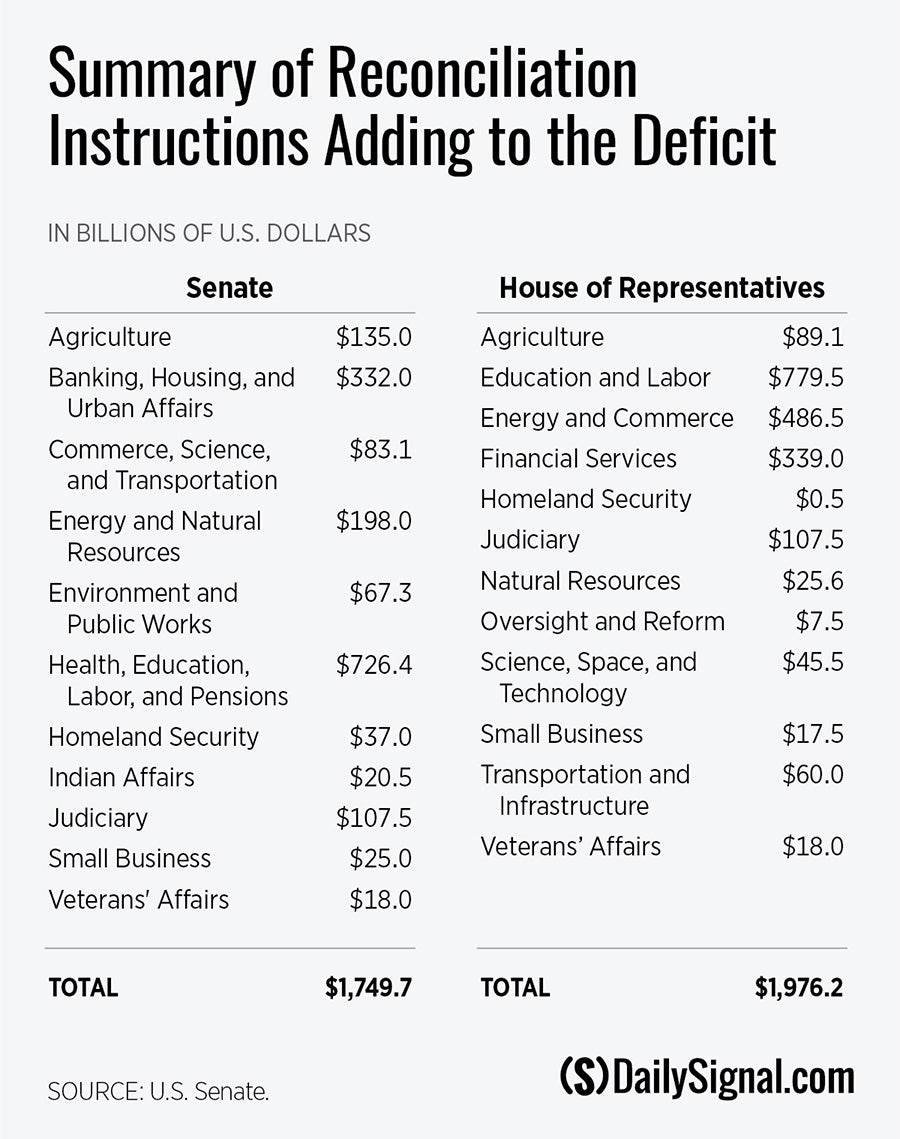
Democrats’ own estimates are that this budget would increase federal spending by more than $4.16 trillion through fiscal year 2031. However, it’s also important to see how much they want to increase spending in just the first year: at least $1.75 trillion.
That is how much the reconciliation instructions would allow them to increase the deficit by. So, just with this single year’s budget, Biden and congressional Democrats would be able to avoid the filibuster to add $1.75 trillion to the deficit.
In truth, with the unlimited ability to raise taxes in this budget, there is no real cap on how much they could spend through reconciliation either.
Further, this budget contains several provisions implying spending on various projects, including infrastructure (read as whatever they define as “infrastructure” today). It should also be noted that the tax code can be utilized to effectively create new spending programs.
4. Path to a Debt Crisis
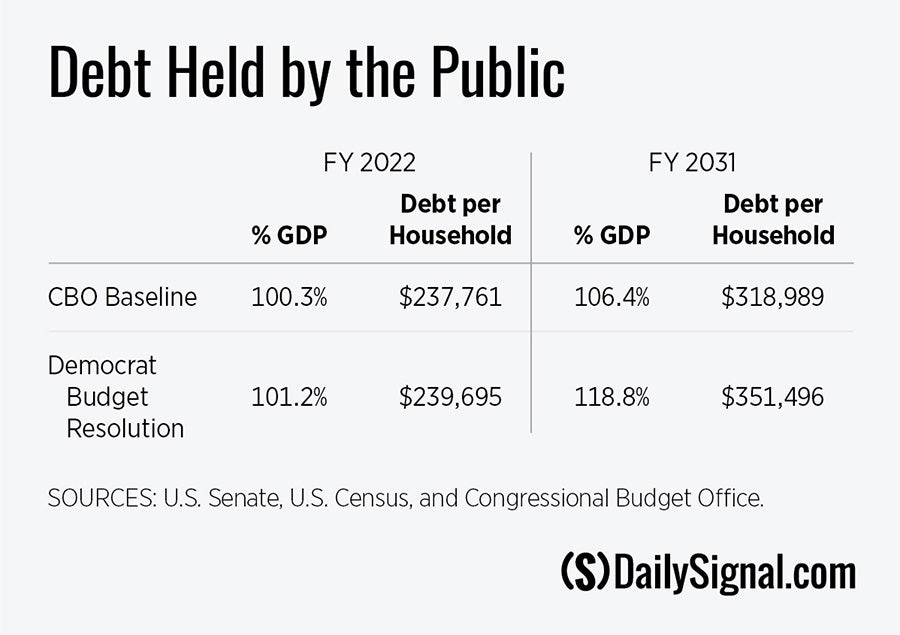
Not only would this plan increase the publicly held debt by more than $4.16 trillion, bringing it to more than 118% of gross domestic product, but it would leave us with well over $2.2 trillion annual deficits by fiscal year 2031. In fact, this plan would envision spending over $1 trillion in fiscal year 2031 just on the net interest for the federal debt.
At a minimum, similar to a tax increase, this new debt would represent the federal government crowding out private investment and stifling wage and job growth. Ultimately, this would set us further down the path toward an unrecoverable debt crisis.
5. Recipe for Inflation
While some of the recent trend of higher inflation is related to the pandemic, it is mostly the result of our reckless federal fiscal policy—which this budget would double down on.
When the federal government increases taxes and crowds out private investment it stifles economic activity. This reduction in real productivity leads to higher rates of inflation as more dollars are chasing fewer goods and services.
To compound this crisis, the Federal Reserve would likely print trillions of more dollars to finance a portion of this deficit spending. In fact, since the start of the pandemic, 54% of the new federal debt ($2.8 trillion) has come from newly printed cash flooded into the economy by the Fed.
The exponentially higher rates of deficit spending, taxation, and money printing that would result from this budget would only serve to exacerbate the current inflationary trend.
6. Breaking Biden’s Infrastructure Promise
During this summer’s negotiations over the bipartisan infrastructure bill, many conservatives warned that any concessions made by Democrats would be undone by using reconciliation to get the rest of what the left wants for urban transit and passenger rail.
To keep Republicans at the negotiating table, Biden said he was willing to give up some of the transportation spending that he wanted, and reserve reconciliation for areas not related to infrastructure, such as social and environmental programs.
The Senate budget resolution breaks this promise by giving $60 billion in reconciliation instructions to the House Transportation and Infrastructure Committee, on top of the $1.1 trillion infrastructure deal.
The summary from the Senate Budget Committee explicitly states that the reconciliation instructions are expected to be used to increase spending on items already covered by the infrastructure bill, including transit improvements, investments in transportation, ports, and clean vehicles.
This shows that months of infrastructure negotiations were done in bad faith.
7. Loopholes and Gimmicks
The point of a budget is to establish responsible fiscal priorities and set up guardrails to assure Congress meets those goals.
However, this budget resolution is filled with loopholes and gimmicks that will make it easier to increase spending.
For the reconciliation bill, the budget resolution waives points of order against increasing the deficit within the budget window and over the long term.
It also includes several reserve funds and adjustment authorities that will allow the chairman of the Budget Committee in the House and Senate to retroactively adjust the levels and allocations in the budget resolution. This is particularly relevant because the budget resolution hides the fact that congressional Democrats are calling for trillions of dollars in tax increases. Instead, those revenue increases will have to be accounted for in the budget later.
The budget resolution also repeals a point of order in the Senate against designating spending as an emergency, which exempts it from the normal budgetary enforcement procedures.
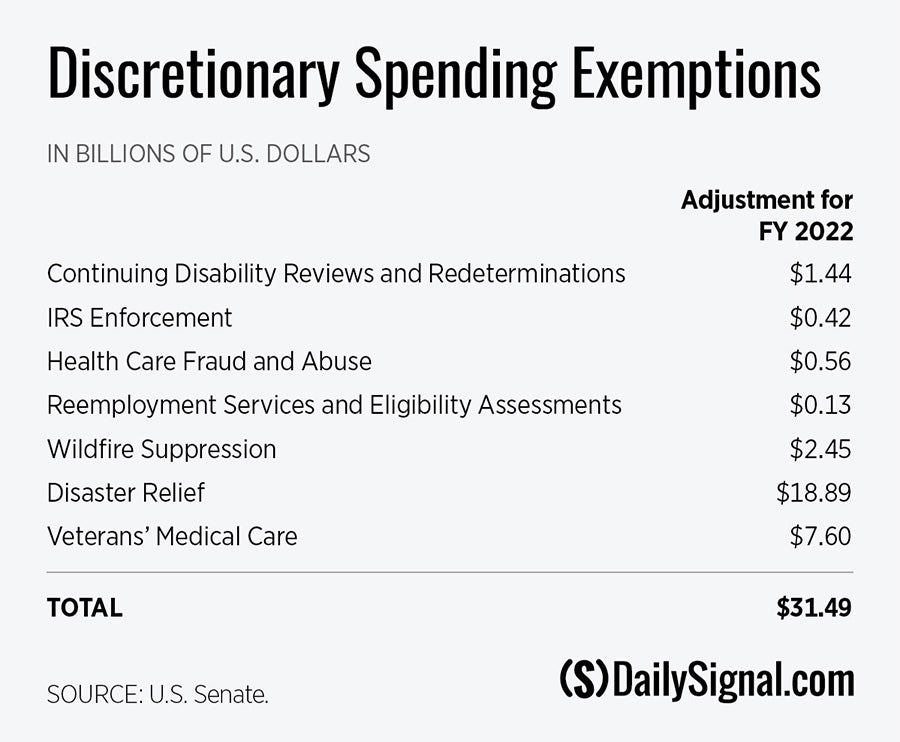
The budget resolution allows the chairman of the Budget Committee to adjust the 302(a) allocation, which sets the overall amount that the Appropriations Committee can spend, if the appropriations bills include funding for certain categories of spending. This adjustment effectively exempts $31.485 billion of spending from the normal discretionary spending levels.
With the expiration of the Budget Control Act caps, these exemptions are no longer necessary, and only serve to weaken the need for Congress to prioritize these categories of spending over low-priority programs.
8. Mistaken Priorities
Despite the trillions in higher spending in this budget resolution, it still manages to shortchange the core constitutional responsibility of national security.
Compared to the Congressional Budget Office’s baseline, this budget resolution would reduce national defense budget authority by $391 billion over the 2022-2031 period. For fiscal year 2022, it does not even match the level marked up by the Senate Armed Services Committee.
9. Fails to Address the Biggest Fiscal Challenges
This budget resolution fails to tackle the nation’s most important fiscal challenges, while likely making future reforms to forestall a crisis even more difficult. Any meaningful fiscal reform must tackle the unsustainable entitlement programs, including Medicare, Medicaid, subsidies for private health insurance, and Social Security.
Without reforms, the Medicare Hospital Insurance Trust Fund will be depleted in 2027 and the Social Security Trust Fund will be depleted in 2032, according to the Congressional Budget Office.
The looming insolvency of the federal government’s two largest programs should be a wake-up call for the need to consider serious changes that would result in better outcomes for those who depend on these programs.
When the Social Security Trust Fund is depleted, it will trigger an immediate 25% benefit reduction, which translates into a low-income earner’s benefit falling by $3,700, to $11,200 per year. Already, Social Security takes 12.4% of workers’ paychecks; keeping it solvent would require a 33% increase in the payroll tax, to 16.5%, or an extra $102,000 in Social Security taxes for an average worker.
Workers shouldn’t have to give up so much of their earnings for a program that’s a terrible deal for most Americans.
By shifting to a smaller, more targeted Social Security program, policymakers could actually help create a significantly larger economy, with higher incomes, greater personal savings, and generations of Americans less dependent on their children and grandchildren.
Congress Must Reject This Budget Resolution
Instead of this budget resolution, Congress should follow a responsible fiscal path that begins to confront the problem of overspending and a federal government that is already too burdensome and unsustainable.
Have an opinion about this article? To sound off, please email letters@DailySignal.com and we’ll consider publishing your edited remarks in our regular “We Hear You” feature. Remember to include the URL or headline of the article plus your name and town and/or state.
Wrap-Up: A Path Forward to Reclaiming our Country
By Cheryl Sullenger
Sioux Falls, SD — Drama was not lacking on the final day of Mike Lindell’s Cyber Symposium, which was held in Sioux Falls, South Dakota, and featured striking evidence of election fraud and a plan to secure our elections. Despite the attempts to disrupt and discredit it, the Symposium was successful at showing new evidence of election fraud, clarifying various aspects of the 2020 Presidential Election, and outlining paths forward for auditing all fifty states and making our future elections secure and trustworthy.
As noted previously, the day began with an announcement by Mike Lindell that he had been physically attacked at his hotel the previous night. He also informed the gathering that another unnamed Colorado official has his home raided at around 10:30 p.m., frightening his wife and four children. Electronic devices were seized. This follows the raid on the office of Mesa County Colorado’s Clerk of Records, Tina Peters, as she was on a flight to South Dakota for the Symposium.
Col. Phil Waldron then briefed the Symposium on several threats that had been detected by his team, including infiltration of the venue by members of Antifa, who also were outside the Symposium venue attempting to disrupt it. He described their behavior as “typical insurrection-type activity” that was part of the color revolution that is ongoing in our nation and is attempting to divide us. See briefing video above.
[Read a good article explaining tactics of color revolutions.]
“Poison Pill”
In his briefing, Col. Waldron also described a credible threat that a “poison pill” had been inserted into their data. His team managed to find the malicious code and eliminate it before it could be released. Col. Waldron indicated that if that had not been done, some people would have been placed at risk. The attack was being handled in accordance with the Cyber Security Act of 2015 and various Executive Orders and has been reported to the appropriate authorities.
Later Col. Waldron explained during a televised interview with OANN that one of their main team members had to pull out of the Symposium due to health issues, and that impacted their ability to discuss some information they had planned to present. This, and the “poison pill” incident may be why the Packet Capture data was not more fully discussed during the Symposium, although details related to the Packet Captures is still unclear.
Freedom of Speech
Attorney Alan Dershowitz discussed Dominion Voting Systems’ defamation lawsuits against Mike Lindell and his My Pillow company, noting that the government is engaged in censorship. As Dr. Shiva Ayyadurai explained during his presentation on Day 2, this is being done through the use of news and social media platforms.
“McCarthyism has become a tactic of the extreme left,” Dershowitz warned.
“Censorship has been long experienced by those of us who work to end abortion,” said Operation Rescue President Troy Newman. “For years the issue was ignored as we were lied about, vilified, and censored by the mainstream fake news and social media. Now that it is happening to others, people are beginning to wake up to the fact that our Freedom of Speech has been nearly obliterated at the behest of those in the government who oppose us.”
Mock Election
During the Symposium, a mock election was conducted using the same voting equipment that was used in several states during the 2020 election. Participants were invited to use the machines to cast their votes.
A panel discussion about the mock election results featured Draza Smith, who holds a Master’s Degree in electrical engineering and a second Master’s Degree in cyber engineering. She explained how the system worked and revealed that someone inside the venue was able to hack the system in five minutes using a cell phone. The intrusion was detected within minutes and the hacker was locked out, but the demonstration proved how easy it was to hack voting machines during the election.
The primary reason for the ease of the hack was a wireless modem attached to the motherboard of the voting machines – something some election officials did not even know was there. That modem allowed connection through a wireless network.
This demonstrated that the machines were in fact accessible over the Internet despite not being hardwired to it.

Amir’s Weekly Report
|





FOX NEWS EDITS TRUMP. WHAT HE REALLY SAID
WOW. So I went to post a clip from President Trump's great interview from @FoxNews last night, and lo and behold, Fox News EDITED and CHANGED what President Trump said, censoring out 45 accurately describing the Fake Election.
Here is what President Trump said: pic.twitter.com/4aNKXioky4
— Liz Harrington (@realLizUSA) August 8, 2021





FOREVER 45
https://canadafreepress.com/article/trump-administration-accomplishments
Before the China Virus invaded our shores, we built the world’s most prosperous economy
- America gained 7 million new jobs – more than three times government experts’ projections.
- Middle-Class family income increased nearly $6,000 – more than five times the gains during the entire previous administration.
- The unemployment rate reached 3.5 percent, the lowest in a half-century.
- Achieved 40 months in a row with more job openings than job-hirings.
- More Americans reported being employed than ever before – nearly 160 million.
- Jobless claims hit a nearly 50-year low.
- The number of people claiming unemployment insurance as a share of the population hit its lowest on record.
- Incomes rose in every single metro area in the United States for the first time in nearly 3 decades.

IS BECOMING A CHRISTIAN TOO EASY TO BE TRUE?
Scripture: Romans 5:17b
“All who receive God’s wonderful, gracious gift of righteousness will live in triumph over sin and death through this one man, Jesus Christ” NLT
“When he discovered a pearl of great value, he sold everything he owned and bought it” NLT
Scripture: Matthew 13:45
“Again, the Kingdom of Heaven is like a pearl merchant on the lookout for choice pearls” NLT
IS BECOMING A CHRISTIAN TOO EASY TO BE TRUE?
Copyright (c) 2021 Pastor Bill Christian Cross Ministries All Rights Reserved
Mailing Address: Christian Cross Ministries P.O. Box 406 Cambridge MN 55008, USA
The story is told of David Morse an American missionary to India who became great friends there with the pearl-diver, Rambhau. Many an evening he spent in Rambhau’s cabin reading to him from the Bible, and explaining to him God’s way of salvation.
Rambhau enjoyed listening to the Word of God, but whenever the missionary tried to get Rambhau to accept Christ as his Saviour he would shake his head and reply, “Your Christian way to heaven is too easy for me! I cannot accept it. If ever I should find admittance to heaven in that manner I would feel like a pauper there — like a beggar who has been let in out of pity. I may be proud but I want to deserve — I want to earn my place in heaven and so I am going to work for it.”
Nothing the missionary could say seemed to have any effect on Rambhau’s decision, and so many years slipped by. One evening, however, the missionary heard a knock on his door, and on going to open it he found Rambhau there.
“Come in, dear friend,” said Morse.
“No,” said the pearl-diver. “I want you to come with me to my house, Sahib, for a short time I have something to show you. Please do not say ‘No'”.
“Of course I’ll come,” replied the missionary. As they neared his house, Rambhau said: “In a week’s time I start working for my place in heaven; I am leaving for Delhi and I am going there on my knees.” “Man, you’re crazy! It’s nine hundred miles to Delhi, and the skin will break on your knees, and you will have blood-poisoning or leprosy before you get to Bombay.”
“No, I must get to Delhi,” affirmed Rambhau, “and the immortals will reward me for it! The suffering will be sweet for it will purchase heaven for me!”
“Rambhau, my friend you can’t. How can I bear you to do it when Jesus Christ has suffered and died to purchase heaven for you!”
But the old man could not be moved. “You are my dearest friend on earth, Sahib Morse. Through all these years you have stood by me in sickness, in want you have been sometimes my only friend. But even you cannot turn me from my desire to purchase eternal bliss — I must go to Delhi!” Inside the hut Morse was seated in the very chair Rambhau had specially built for him — where on so many occasions he had read to him the Bible.
Rambhau left the room to return soon with a small but heavy English strongbox. “I have had this box for years,” said he, “and I keep only one thing in it. Now I will tell you about it, Sahib Morse. I once had a son —”
“A son! Why, Rambhau, you have never before said a word about him!”
“No, Sahib, I couldn’t.” Even as he spoke the diver’s eyes were moistened.
“Now I must tell you, for soon I will leave, and who knows whether I shall ever return? My son was a diver too. He was the best pearl diver on the coasts of India. He had the swiftest dive, the keenest eye, the strongest arm, the longest breath of any man who ever sought for pearls. What joy he brought to me! Most pearls, as you know, have some defect or blemish only the expert can discern, but my boy always dreamed of finding the perfect pearl — one beyond all that was ever found. One day he found it! But even when he saw it he had been under water too long — That pearl cost him his life, for he died soon after.”
The old pearl diver bowed his head. For a moment his whole body shook, but there was no sound. “All these years,” he continued, “I have kept this pearl but now I am going, not to return, and to you, my best friend I am giving my pearl.”
The old man worked the combination on the strongbox and drew from it a carefully wrapped package. Gently opening the cotton, he picked up a mammoth pearl and placed it in the hand of the missionary. It was one of the largest pearls ever found off the coast of India, and glowed with a luster and brilliance never seen in cultured pearls. It would have brought a fabulous sum in any market.
For a moment the missionary was speechless and gazed with awe. “Rambhau!
What a pearl!”
“That pearl, Sahib, is perfect,” replied the Indian quietly. The missionary looked up quickly with a new thought: Was not this the very opportunity and occasion he had prayed for to make Rambhau understand the value of Christ’s sacrifice? So he said, designedly, “Rambhau, this is a wonderful pearl, an amazing pearl. Let me buy it. I would give you ten thousand dollars for it.”
“Sahib! What do you mean?”
“Well, I will give you fifteen thousand dollars for it, or if it takes more I will work for it.”
“Sahib,” said Rambhau, stiffening his whole body, “this pearl is beyond price. No man in all the world has money enough to pay what this pearl is worth to me. On the market a million dollars could not buy it. I will not sell it to you. You may only have it as a gift.”
“No, Rambhau, I cannot accept that. As much as I want the pearl, I cannot accept it that way. Perhaps I am proud, but that is too easy. I must pay for it, or work for it.”
The old pearl-diver was stunned. “You don’t understand at all, Sahib. Don’t you see? My only son gave his life to get this pearl, and I wouldn’t sell it for any money. Its worth is in the life-blood of my son. I cannot sell this but I can give it to you. Just accept it in token of the love I bear you.”
The missionary was choked, and for a moment could not speak. Then he gripped the hand of the old man. “Rambhau,” he said in a low voice, “don’t you see?
My words are just what you have been saying to God all the time.”
The diver looked long and searchingly at the missionary, and slowly, slowly he began to understand. “God is offering to you salvation as a free gift,” said the missionary. “It is so great and priceless that no man on earth can buy it. Millions of dollars are too little. No man on earth could earn it in a million years. No man is good enough to deserve it. It cost God the life-blood of His only Son to make the entrance for you into heaven. In a million years, in a hundred pilgrimages, you could not earn that entrance. All you can do is to accept it as a token of God’s love for you — a sinner — saved by HIS grace.
“Rambhau, of course I will accept the pearl in deep humility, praying God I may be worthy of your love. Rambhau, won’t you accept God’s great gift of heaven, too, in deep humility, knowing it cost Him the death of His Son to offer it to you?”
Great tears were now rolling down the cheeks of the old man. The veil was beginning to lift. “Sahib, I see it now. I have believed in the doctrine of Jesus for the last two years, but I could not believe that His salvation was free. Now I understand. Some things are too priceless to be bought or earned. Sahib, I will accept His salvation!”
Prayer: Father thank you for priceless salvation through Your Son Jesus which is a free gift to all who receive him. In the name of the Lord Jesus Christ. Amen!
Copyright (c) 2021 Pastor Bill Christian Cross Ministries All Rights Reserved
Mailing Address: Christian Cross Ministries P.O. Box 406 Cambridge MN 55008, USA


The Last Days of New York
https://gellerreport.com/2021/08/the-last-days-of-new-york.html/
New York Is A Cautionary Tale About The Dangers of Progressivism
By Auguste Meyrat, The Federalist: July 30, 2021
Perhaps the best argument a conservative can make when defending his political views is to simply point to the failings of any blue state. By any metric, these states generally do poorly, which has led to residents in these states migrating to red states like Texas and Florida.
Seeing that no progressive leader campaigns on the promise to limit people’s freedoms, bankrupt the government, and fail to deliver basic social services, it’s not altogether clear why this seems to constantly happen when leftists are in charge. It has something to do with progressivism, sure, but it becomes necessary to delve into details for a comprehensive explanation.
Fortunately, Seth Barron gives this explanation with his new book, The Last Days of New York: A Reporter’s True Tale. With great detail and a wry sense of humor, he charts the downward course of New York City from a world-class city that could thrive even after suffering one of the worst terrorist acts in history to a dysfunctional concrete jungle that is quickly deteriorating into a crime-infested ghost town.
The protagonist of this story is Mayor Bill de Blasio, an embodiment of mediocrity and hypocrisy. Barron notes that “Bill de Blasio was flower, fruit, and fragrance” of New York’s progressive political culture.
He is the son of two Ivy League-educated parents, both with connections to elites in media and government, as well as the Communist Party. After his father committed suicide, de Blasio eventually changed his name from Warren Wilhelm to Bill de Blasio, his mother’s maiden name. He attended Greenwich college and then Columbia, earning a graduate degree in Latin American politics, which he put to use by working for a pro-Sandinista nonprofit organization and engaging in Marxist advocacy.
In 1994, de Blasio married the black one-time lesbian activist Chirlane McCray and had his honeymoon in Castro’s Cuba. They had two children who have also become activists. As Barron reports, the couple was “aggressive about using their children as props, highlighting Chiara’s depression and substance abuse in pushing McCray’s mental-wellness initiatives and Dante’s experiences as a young black man dealing with the police.”
In his professional life, de Blasio worked on various campaigns, was a consultant for a health-care workers union, and eventually was elected to the city council. After pandering to every constituency in the city, he was elected mayor and resumed his activist platform, promoting socialism, denouncing police, defending violent criminals and terrorists, combatting illusory racism—all while letting his city fall into neglect.
De Blasio’s Ascendency
The first thing to go upon de Blasio’s ascendency to the office of mayor was law and order. Right before this, the city was the model for urban law enforcement because of the broken-windows and hotspot policing of Rudy Giuliani and the continued resilience of Mike Bloomberg, who introduced stop, question, and frisk (SQF) to crack down on illegally owned firearms.
In line with his leftist ideals, de Blasio instead declared war on the police and dismantled the protections they enjoyed under previous administrations. He determined that strategies like SFQ and broken-windows policing were racist and let them fall into disuse or actively blocked them. He then hired on race-hustler Al Sharpton as a consultant for law enforcement while alienating his police force.
Sensing a tacit endorsement with the new mayor, anti-police protesters (pre-Black Lives Matter) took action and openly assaulted police during a march on Brooklyn Bridge in 2013. A few weeks later, two policemen were murdered in cold blood by a deranged man inspired by anti-police rhetoric. Adjusting to the new reality, police started holding back in their duties. De Blasio and the city council went even further by instituting the “Right to Know Act” which, as Barron explains, “makes basic police work impossible by forcing cops to act as impromptu legal aid interpreters for the suspects they are trying to investigate.”
As he undermined his police department, de Blasio took up the cause of illegal immigrants in his city. Even though previous administrations largely protected them, they apparently did wrong by cooperating with U.S. Immigration and Customs Enforcement (ICE) to address aliens who also committed violent crimes. De Blasio ended this relationship, evidently preferring violent criminals living in his city illegally over their victims.
Barron draws a straight line between this decision and the horrific crime in which 21-year-old illegal immigrant Reeaz Khan raped and murdered 92-year-old Maria Fuertes. Predictably, de Blasio took no responsibility and blamed ICE, Donald Trump, and racism for the crime. This kind of attitude led to a series of decriminalization efforts that were meant to combat the supposed evils of xenophobia and racism, even as they effectively made New Yorkers less safe.
De Blasio paired decriminalization with bail reduction and decarceration. Barron notes these movements are nearly all based on simplistic narratives and partial truths.
For example, leftists will take a story like that of Kalief Browder, who committed suicide after serving three years in jail for stealing a backpack, who was too poor to post bail. Barron corrects this line by pointing out that Bowder did much more than steal a backpack (he assaulted and robbed a Mexican immigrant, violating his probation for stealing and crashing a bakery truck) and was thus ineligible for bail. He doesn’t give these details as proof that Browder should have suffered as he did, but to show how leftist leaders like de Blasio ignore facts that complicate their misleading narratives.
In a similarly obtuse fashion, de Blasio took on the city’s economic inequality, blithely asserting in his 2019 “state of the city” address, “Brothers and sisters, there’s plenty of money in the world. There’s plenty of money in this city. It’s just in the wrong hands.”
To rectify this, he blew out the city’s budget on paying off interest groups like the United Federation of Teachers, useless initiatives like “New York Works” and “Renewal Schools” programs, hiring more unionized city workers, and filing ridiculous lawsuits against all major oil producers. Despite this spending, the city’s businesses have fled the city, leaving its finances in a more precarious position than ever.
Moreover, as the city grew poorer and laxer with law enforcement, homelessness became a bigger problem. By now the pattern for de Blasio’s leftist “reforms” had become familiar: misjudge the problem and let it fester while spending tons of taxpayer money on useless programs. As such, to deal with the homelessness, de Blasio cited the lack of affordable housing as the culprit for homelessness and paid more than $1 billion for substandard homeless shelters and rehabilitation programs, all while refusing to address the vagrants and junkies harassing people in public parks and libraries.
In the following chapter, Barron shows how the same leftist logic played out with helping the mentally ill. De Blasio’s wife ran a series of initiatives under the banner “Thrive NYC,” emphasizing prevention, destigmatizing mental illness, and additional counseling. Predictably, the program was a bust since stigma against seeking treatment hardly exists and most people with mental illness require far more than counseling to function. As a result, thousands of mentally ill people continued to go untreated and posed a daily threat to other residents.
Meanwhile, New York’s youth continue to languish in inferior schools (that is, when lockdown don’t force them to languish at home) run by corrupt teacher unions and radical leftist district leaders, even as the city spends more than $25,000 per student each year. As usual, when called to account, those in charge blame racism and inequality.
De Blasio’s remedy was to provide universal pre-kindergarten, which ended up being funded by taxpayers across the state. His district superintendents Carmen Farina and Richard Carrazana remedied other problems by removing screening admission tests, ignoring testing data, and implementing critical race theory training for teachers.
The Cycle of Corruption
In his second to last chapter, Barron wraps up by discussing how New York City’s dysfunction originates from parasitic leftist organizations that perpetuate a cycle of corruption: “Much of the problem—unsurprisingly—lies in New York’s interlinked networks of donors, party bosses, unions, and consultants, who choose candidates, fund them, and essentially control them once they’re in office.” Barron does yeoman’s work connecting the many dots between so many groups, like the WFT, CONY, ACORN, AKPD, NWRO, and several more.
This corrupt web leaves little hope for new leadership to come clean up the mess. After all, incompetent activists and consultants are drafted into government positions, then use their authority to enrich the groups they left. They take businesses for granted because they’ve never worked for a business. They think government spending is the solution for everything because they themselves are the beneficiaries of government largess.
Even if an outsider sees de Blasio as a total failure of a mayor, there’s little reason to think that someone better will replace him. As Barron puts it, “If you are a city employee, he expanded your workforce, rewarded you with good contracts, and protected your job. If you run a political consultancy, he enriched you. If you work for an activist nonprofit organization, he supported you. If you are a hard-left activist or aspiring politician, he gave you a pivot to swing the city further left, because he didn’t.” Consequently, anyone who doesn’t do all these things and more will not win elections.
While Barron concedes that NYC is not quite a hellscape yet, it’s far from its former greatness. “All this may not amount to ‘anarchy’ in a purist’s sense of the word, but it isn’t the New York City that Bill de Blasio inherited either,” he writes. His book ends with a disturbing account of a man who aimed a crossbow at him while he was walking his dog. After discovering that the man had a long criminal history, Barron reported the incident and the police took the man in custody for a brief time before… releasing him.
Overall, The Last Days of New York is a valuable and fascinating case study on the effects of leftist leadership. Although frequently dispiriting, it upholds the analysis and predictions of those who resist the currents of leftism. It isn’t sustainable, it ushers in widespread corruption, and it’s destructive.
It’s a shame that the residents of America’s greatest city have to suffer from their poor selection of leaders. But it would be even more shameful the rest of the country fails to heed the lessons in Barron’s book and suffers the same fate as de Blasio’s New York.