
BASICS OF CHRISTIANITY – Part I
Basics of Christianity
Basics of Christianity is a great place for you to learn more about some important topics. If you haven’t taken that step but want to learn more about what Christians believe in your own search for truth, start here! This section covers topics like: What is sin, and what does salvation mean? Is it possible to resist temptation? How should we pray? And how can you tell others about Christ? Find answers to these questions and more in Basics of Christianity.
People often ask, “What makes Jesus different from all the other religious leaders who ever lived?” Well, the Bible—God’s authoritative word—makes it very clear that Jesus was more than just another religious teacher or prophet. It tells us, instead, that Jesus was unique. First, He was unique in His person. He wasn’t just an unusually spiritual individual. He was more than that; He was God in human flesh.
Yes, He was fully man, but He was also fully God. The Bible puts it this way: “For in Christ all the fullness of the Deity lives in bodily form” (Colossians 2:9). This is what we celebrate at Christmas—God coming to earth in the form of man. Second, Jesus was unique in His purpose. Why did He come to earth? He came for one reason: to save us from our sins. As Jesus Himself said, “For the Son of Man came to seek and to save what was lost” (Luke 19:10).
First their were all kinds of animal sacrifice, but Jesus became the final sacrifice for our sins through His death on the cross, because He was perfect, male, without blemish, and all the things a sacrifice had to be. We know His promise of eternal life is true because He did something no other person has ever done: He rose from the dead—what we call the resurrection—and still lives today.
The Bible is somewhat like a library because it is actually a collection of books. Those books were written over many centuries, and they were only gradually brought together into their present form.
The first “collection” was probably the first five books of the Bible (often called the “Torah,” which is the Hebrew word for God’s Law). Jesus came here to earth as a Hebrew.
As time went on, other books were added. The whole Old Testament was finished about four centuries before the time of Jesus.
Only a few decades after His (Jesus) ministry, the books of the New Testament were written and then accepted by Christians.
The most important fact about the Bible, however, is that God watched over its writing, and He has preserved it down to the present time. The Bible isn’t just another ancient book of human wisdom—it is God’s Word, given to us to tell us how we can know God. The Bible says, “For prophecy never had its origin in the will of man, but men spoke from God as they were carried along by the Holy Spirit” (2 Peter 1:21). God guided the authors as they wrote the different books. What place does the Bible have in your life?
God wants to speak to you through its pages; are you listening?
Most of all, He wants you to come to know Him by discovering Jesus Christ, who is at the center of the Bible.
Reading the Bible: The Bible is big—so big that even the greatest scholar will never exhaust its riches. But the Bible isn’t just for preachers and scholars! God wants to speak to you through His Word, and no matter who you are, the Bible can come alive to you. You may never understand everything in the Bible, but you can understand something. Samuel was still a boy when God answered his simple prayer: “Speak, Lord, for your servant is listening” (1 Samuel 3:9). Make that your prayer as well.
So why does the Bible remain a closed book to many? One reason is because we don’t realize how much we need it. If I suggested you stop eating for a few months, you’d ignore me—and rightly so. We need food in order to survive, and without food we’ll grow weak and eventually die. Yet many Christians are spiritually starved and weak because they ignore the spiritual “food” God has provided in the Bible.
The Bible is not an option; it is a necessity. You cannot grow spiritually strong without it. Job said, “I have treasured the words of His mouth more than my daily bread” (Job 23:12). Is the Bible this important to you? How can you discover the Bible’s message? How can the Bible become part of your life? Learn the Bible from others.
God has given some people a special gift to understand the Bible and teach it to others. The Bible says that “in the church, God has appointed … teachers” (1 Corinthians 12:28). Listen carefully when your pastor preaches from the Bible.
Seek out a Bible class in your church or community where only the Bible is taught. Also check your local Christian radio station (if you live in a country that permits religious broadcasting); some of today’s most gifted Bible teachers are on radio.
Investigate spending part of your vacation at a conference center devoted to Bible teaching. Many people find daily devotional books based on the Bible helpful. Although they may examine only a verse or two each day, God can use them to encourage you.
One of the most significant spiritual movements in recent decades has been the explosion in small group Bible studies. All over the world, Christians are coming together to read the Bible and share their insights. The Bible says, “Let the word of Christ dwell in you richly as you teach and admonish one another” (Colossians 3:16).
https://static.billygraham.org/sites/billygraham.org/uploads/pro/2019/08/GF-Basics-of-Christianity.pdf (Edited slightly by this site)

You voted for Biden, you jerkhead!
https://youtu.be/DEnsWZicfAQ
Is Jesus God?
https://www.gotquestions.org/is-Jesus-God.html
Some who deny that Jesus is God make the claim that Jesus never said that He is God. It is correct that the Bible never records Jesus saying the precise words, “I am God.” This does not mean, however, that Jesus never claimed to be God.
Is Jesus God? — Jesus claimed to be God.
Take for example the words of Jesus in John 10:30, “I and the Father are one.” We need only to look at the Jews’ reaction to His statement to know He was claiming to be God. They tried to stone Him for this very reason: “You, a mere man, claim to be God” (John 10:33, emphasis added). The Jews understood exactly what Jesus was claiming—deity. When Jesus declared, “I and the Father are one,” He was saying that He and the Father are of one nature and essence. John 8:58 is another example. Jesus declared, “I tell you the truth … before Abraham was born, I am!” This is a reference back to Exodus 3:14 when God revealed Himself as the “I AM.” The Jews who heard this statement responded by taking up stones to kill Him for blasphemy, as the Mosaic Law commanded (Leviticus 24:16).
Is Jesus God? — His followers declared Him to be God.
John reiterates the concept of Jesus’ deity: “The Word [Jesus] was God” and “the Word became flesh” (John 1:1, 14). These verses clearly indicate that Jesus is God in the flesh. Acts 20:28 tells us, “Be shepherds of the church of God, which He bought with His own blood.” Who bought the church with His own blood? Jesus Christ. And this same verse declares that God purchased His church with His own blood. Therefore, Jesus is God.
Thomas the disciple declared concerning Jesus, “My Lord and my God” (John 20:28). Jesus does not correct him. Titus 2:13 encourages us to wait for the coming of our God and Savior, Jesus Christ (see also 2 Peter 1:1). In Hebrews 1:8, the Father declares of Jesus, “But about the Son He says, ‘Your throne, O God, will last forever and ever, and righteousness will be the scepter of your kingdom.’” The Father refers to Jesus as God, indicating that Jesus is indeed God.
In Revelation, an angel instructed the apostle John to only worship God (Revelation 19:10). Several times in Scripture Jesus receives worship (Matthew 2:11; 14:33; 28:9, 17; Luke 24:52; John 9:38). He never rebukes people for worshiping Him. If Jesus were not God, He would have told people to not worship Him, just as the angel in Revelation did. Beyond these, there are many other passages of Scripture that argue for Jesus being God.
Is Jesus God? — The reason Jesus must be God.
The most important reason that Jesus must be God is that, if He is not God, His death would not have been sufficient to pay the penalty for the sins of the world (1 John 2:2). A created being, which Jesus would be if He were not God, could not pay the infinite penalty required for sin against an infinite God. Only God could pay such an infinite penalty. Only God could take on the sins of the world (2 Corinthians 5:21), die, and be resurrected, proving His victory over sin and death.
Is Jesus God? Yes. Jesus declared Himself to be God. His followers believed Him to be God. The provision of salvation only works if Jesus is God. Jesus is God incarnate, the eternal Alpha and Omega (Revelation 1:8; 22:13), and God our Savior (2 Peter 1:1).
https://www.gotquestions.org/is-Jesus-God.html

What is a biblical definition of faith?
The following is taken from: https://www.compellingtruth.org/definition-of-faith.html
What is a biblical definition of faith?
Hebrews 11:1 says, “Now faith is the assurance of things hoped for, the conviction of things not seen.” This would be the most concise biblical definition of “faith.” But what else does the Bible say about faith?
The Greek word used most often in the New Testament for “faith” is pistis. It indicates a belief or conviction with the complementary idea of trust. Faith is not a mere intellectual stance, but a belief that leads to action. As James 2:26 says, “For as the body apart from the spirit is dead, so also faith apart from works is dead.” James talks about demonstrating his faith by his works. Often what we do says more about what we believe than what we say.
A common example to illustrate faith is that of a chair. I may say I “believe” the chair can hold my weight, but I do not actually put faith in the chair until I sit in it. This is the type of faith required for salvation. Hebrews 11:6 says, “And without faith it is impossible to please him, for whoever would draw near to God must believe that he exists and that he rewards those who seek him.” If we don’t actually trust that God is real and that what He says is true, we won’t come to Him for salvation. Ephesians 2:8–10 says, “For by grace you have been saved through faith. And this is not your own doing; it is the gift of God, not a result of works, so that no one may boast. For we are his workmanship, created in Christ Jesus for good works, which God prepared beforehand, that we should walk in them.”
Faith is an active trust in God, a belief in what He says is true that results in action. When we have faith in God, we believe that we are sinners deserving of eternal punishment (Romans 3:23). We believe that Jesus came into the world to live a perfect life, die on our behalf, and rise again victorious over sin and death (John 3:14–18; Romans 5:6–11; 1 Corinthians 15:3–5, 20–22; 2 Corinthians 5:18–21). We trust in Jesus to save us from our sins. We have faith that He gives us His Holy Spirit, as He promised (John 14:15–17; 16:4–15). We then trust in the Holy Spirit to do His work of sanctification in us (Romans 8; 2 Corinthians 3:18). We live to honor God, relying on His forgiveness and trusting that His ways are truly best (John 15:1–27; Romans 13:8–14; 2 Corinthians 5:17; Colossians 3; 2 Peter 1:3–11).
https://www.compellingtruth.org/definition-of-faith.html
What is Sharia?
What is Sharia?

Earlier this week, UTT published the first in a series of articles about sharia (Islamic law) entitled “Understanding the Threat” which amplified the fact that sharia is the focal point and driving force behind everything jihadis across the globe are doing.
Today, we will breakdown what sharia actually is and its origins.
All Islamic sources define Islam as a “complete way of life governed by sharia.”
According to the most widely used text book in Islamic junior high schools in the United States (What Islam is All About), “The Shari’ah is the ideal path for us to follow.”
There are two sources of sharia: the Koran and the Sunnah.
Islam is the system of life under sharia. Those who submit to Islam and the sharia are called “Muslims.”
The Koran (also Quran or Qur’an)
According to Islam, the Koran is the “uncreated word of Allah,” who is the Islamic god, and the contents of the Koran were revealed to the Prophet Mohammad between the years 610 A.D. and 632 A.D. in the Arabian peninsula through an angel. The Koran has 114 chapters or “suras” which are arranged in no particular order. They are generally arranged by size from largest to smallest. However, the first chapter is approximately the smallest, and the sizes of the chapter vary so this is not a perfect rule.
The Islamic scholars have authoritatively listed the chapters of the Koran in chronological order. This is very important because Allah said in the Koran (2:106, 16:101) that whatever comes chronologically last overrules anything that comes before it. This is called “abrogation.” Allah revealed his message to Mohammad progressively over time. By the time it was all revealed, what came last was the most important and overrules anything that was said earlier.
“It is a Qur’an which We have divided into parts from time to time, in order that though mightest recite it to men at intervals: We have Revealed it by stages.” (Koran 17:106)
So, for instance “Let there be no compulsion in religion” (Koran 2:256) is overruled or abrogated by “Whoever seeks a religion other than Islam will never have it accepted of him” (Koran 3:85) which is why we get “Take not the Jews and the Christians as your friends…” (Koran 5:51). Chapter 5 in the Koran is the last chronologically to speak about relations between Muslim and non-Muslims.
Chapter 9 is the last to discuss jihad.
“Fight and slay the unbeliever wherever you find them, capture and besiege them, and lie in wait for them in each and every ambush (strategem of war).” (Koran 9:5)
Furthermore, every verse in the Koran has been legally defined in the Tafsir. The most authoritative Tafsir scholar in Islam is a man named Ibn Kathir. For instance, the Tafsir defines a portion of verse 9:5 above as follows: “This is the Ayah (verse) of the sword…’and capture them’ (means) executing some and keeping some as prisoners…’and besiege them, and lie in wait for them in each and every ambush’ (means) do not wait until you find them. Rather, seek and besiege them in their areas and forts, gather intelligence about them in the various roads and fairways so that what is made wide looks ever smaller to them. This way, they will have no choice, but to die or embrace Islam.” (Tafsir Ibn Kathir, Vol 4, pages 375-376)

The Tafsir is taught at mosques in the United States on a regular basis. There is no such thing in Islam as a “personal interpretation” of a particular verse of the Koran.
The Sunnah
The Sunnah is the example of the Prophet Mohammad who is considered the al Insan al Kamil in Islam – the most perfect example of a man. If Mohammad did it or said it, it is an example for all Muslims to follow for all time.
His words and deeds are recorded in the authoritative biographies (Sira) and the collection of the Hadith or stories about him. In Islam there are many Hadith scholars, but the most authoritative are by men named Bukhari and Muslim.
The Prophet said, “The hour of judgment will not come until the Muslims fight the Jews and kill them. It will not come until the Jew hides behind rocks and trees. It will not come until the rocks or the trees say, ‘O Muslim! O servant of God! There is a Jew behind me. Come and kill him.” Al-Bukhari: 103/6, number 2926. Volume: Jihad; Chapter: Fighting the Jews
The above quote from Mohammad is doctrine in Islam. Mohammad said it and it is authoritatively recorded by Bukhari, the most authoritative hadith scholar in all of Islam. This is why the above quote is not only in the Hamas Covenant, it is taught at the first grade level in Islamic schools.
Example: Why is it okay for a 60 year old Muslim man to marry an 8 year old girl? Because Mohammad married Aisha when she was six (6) years old and consummated the relationship when she was nine (9). Mohammad is the perfect example, therefore, it is a capital crime in Islam to suggest this is wrong behavior.
The Koran, as understood with the Koranic concept of abrogation, and the Sunnah form the “Sharia” or the way for all Muslims to follow. This is a totalitarian legal system and cannot be altered or amended because it comes from Allah and was exemplified by the actions and words of Mohammad. Therefore, when it comes to the definition of jihad, the obligation of jihad, the law of jihad, the obligation of the Caliphate (Islamic State), the rules under the Caliph, and relations between Muslims and non-Muslims, there is no disagreement among any of the scholars.
If Allah said it chronologically last in the Koran, Mohammad said it, and Mohammad did it, how could there be a legal “gray area” in sharia?
- “Fight and slay the unbeliever wherever you find them, capture and besiege them, and lie in wait for them in each and every ambush (strategem of war).” (Koran 9:5)
- Mohammad said: “I have been commanded to fight people until they testify that there is no god but Allah and that Mohammad is the Messenger of Allah.” Hadith reported by Bukhari and Muslim
- Mohammad went out and fought many battles against non-Muslims until they converted to Islam or submitted to Islam. Those who did neither were killed.
Any questions? Go to UTT -Understandingthethreat.com

The Threat of Sharia Law
Understanding the Threat

Our enemy identifies itself at the “Global Islamic Movement.” It takes many forms and comes at us in many different ways. The International Muslim Brotherhood (MB) is the primary driving force behind the global Movement, but there are parallel movements aligned with the Brotherhood such as Tablighi Jamaat, Jamaat e Islami and others. These groups focus on brining the Muslim community back to authentic Islam while softening the non-Muslim world to accept their “civilization alternative” to Western culture.
As the Muslim Brotherhood’s by-laws state, they do their work by making “every effort for the establishment of educational, social, economic and scientific institutions and the establishment of mosques, schools, clinics, shelters, clubs as well as the formation of committees to regulate zakat affairs and alms.” Today, across Europe and North America, the Muslim Brotherhood created and controls a large portion of the Islamic organizations. Yet, it is in the United States the MB has their greatest influence.
Apart from the MB and related jihadi movements, there are military jihadi organizations like Al Qaeda, ISIS, Boko Haram, Hamas, Hizbollah, and hundreds of others.
100% of these organizations and their members state they are Muslims waging jihad in the Cause of Allah (Jihad Fisabilillah) in order to establish the caliphate under sharia.

Sharia is everything in this war. It is what the enemy seeks to impose on the world, and it is the blueprint for how they do everything they do. That is why sharia is taught at the first grade level to Muslims in Islamic schools and mosques across the planet. Islam teaches that Islam is “a complete way of life” – social, cultural, political, military, and religious – governed by sharia (Islamic Law).
100% of all published sharia obliges jihad until the world is under Islamic rule. 100% of sharia only defines jihad as “warfare against non-Muslims.”
Sharia is a totalitarian system of governance, not a religious edict.


Why don’t “moderate Muslims” teach a softer “version” of Islam? Because it is a capital crime in Islam for a Muslim to teach another Muslim something that is not true about Islam. You would actually have to read sharia to know this.
Hint: When buying books on Islam, do not go to your local bookstore. Go to the mosque bookstore and buy books written by Islamic authorities for a Muslim audience. Then ask yourself “Why is this information exactly opposite of the information that is written in books for the non-Muslim audience?”

Sharia is the threat doctrine of our enemy. If you read and understand Sharia, you will: know why Muslims yell “Allahu akbar” before they commit an act of jihad; understand why in 15 years “Islamic advisors” to our government have not mentioned that “Jihad” is only defined in Islamic law as “warfare against non-Muslims”; and you will see why “Islamophobia” is not a random term but a term of art meant to identify people who violate the Islamic Law of Slander (a capital crime in Islam), which is defined as saying anything about a Muslim or Islam that a Muslim would “dislike.”
Sharia is the threat doctrine. Those who practice Sharia and seek to impose it by all means necessary are the threat.

There is only one organization in the United States teaching law enforcement, military, and community organizations about the Muslim Brotherhood’s jihadi Movement and network here, their doctrine (Sharia), their modus operandi, and ways law enforcement can identify and defeat the network in their area – Understanding the Threat (UTT).
UTT intends on fighting the good fight until the fight is done. UTT needs allies who know and understand the threat. Join us!



85 Things You Can Do: Help America Be Wide Awake
By Joy Pullmann
While helming Fox’s “Primetime” last week, Federalist Publisher Ben Domenech developed in his nightly monologues the theme of Americans becoming, not woke, but “Wide Awake.”
The “Wide Awake” label comes from another fraught period in American history. It was the name of a highly effective grassroots political movement in the pre-Civil War era.
“There were hundreds of thousands of [Wide Awakes] in 1860, and their organizations stretched from Maine to California,” Domenech explained last Monday. “They were a militaristic fraternity dedicated to human liberty. They had banners and marches and baseball teams. They carried oil lamps, wore capes, and wielded bats, and they stumped for a rising Republican rail-splitter named Abraham Lincoln.”
Throughout the week, Domenech called on Americans to consider this historical example to inform our actions today, in another era of despair, mob rule, political corruption, and a brutal coalition of elites and lowlifes against the aspiring middle class. Amid lockdowns, rising inflation, state-sponsored racism, doubt about the security of elections, the fecklessness of politicians, and the leftist control of everything right down to whether we can show our faces, many Americans feel hopeless and in rout.
This, Domenech argued, is the time not to slide into the sleep of despair, but to stomp our feet on the sleep-inducing fumes and shake ourselves awake for action: “The American crisis can be the opportunity for American renewal. That’s why it’s worth doing. It’s only by doing hard things and overcoming them that we find genuine happiness.”
“What does it mean to be wide awake? What are you prepared to do if you are?” Domenech asked in his Friday conclusion to the week’s series.
I’m not quoting Ben because he’s my boss, but because he’s 100 percent right, and he has more heart than I do most days, and that’s right, too. To follow up on this theme, I and several Federalist staff have compiled the following idea list of ways to develop your capacity for self-governance. Many people are feeling despair right now, and the truth is that things are likely to get worse before they get better. But for them to ever have a chance of getting better, we have to be willing to suffer today.
But not suffer pointlessly. Suffer with a purpose. Suffer for the cause of making a better future possible for our children and grandchildren. Suffer to preserve and expand our right to freely worship our God and live in fidelity to his commands. Suffer for the nobility of living a life of the deep meaning that can only come from sacrifice rather than the pointless life of constant self-gratification.
Stop talking, and start doing. Create the culture you want to see. Vote not only at election time, but with every day of your life, and every action you take. Self-government starts at home, with you, and now. Here are some places to start, or to start brainstorming more.
1. Run for office.
2. Recruit someone excellent to run for office, and a group of friends to help that person win.
3. Primary a woke or sleeping incumbent.
4. “Start a neighborhood group — present yourself under an umbrella that welcomes all other responsible members of your community who are sick and tired of being sick and tired, and who are willing to stand up.” (quote from Ben’s monologue)
6. Grow some of your own food.
7. Shop at your local farmer’s market, or participate in community-supported agriculture.
8. Shop local for other stuff, too.
9. Cut cable and send the cable payment to something useful, like your local church or a fund to help kids escape public schools.
10. Work out. If you already work out, up your game. If working out is intimidating, just start going for walks. See where it leads, and feel good about doing more than you used to.
11. Play board games with your kids instead of letting them watch some screen.
12. Organize a mass protest against school masking.
13. Start a local online news blog that uses open-records requests to obtain curriculum from the local schools and post screenshots and basic summaries of what you find.
14. Don’t send your kids to schools that medically and socially abuse them. Have education standards that are far above “free babysitting.”
15. Volunteer to coach local kids’ sports.
16. Go to church. Every week.
17. Go to church midweek, too.
18. Go to your church’s Sunday School or education hour before or after the service.
19. Pick up and drive an elderly, handicapped, or otherwise needy person to church on your way.
21. Volunteer through your church.
22. Volunteer at your child’s school.
23. Notice that a neighbor struggles with something, like childcare or lawn care, or loneliness. Do something to help.
24. Invite people over to your house for dinner. If dinner is too intimidating, do drinks or dessert or popcorn.
25. Get to know your neighbors and your neighborhood.
26. Cultivate the art of hospitality, and use it as a tool to build community. Without thriving families and strong, close-knit communities, conservatives will never rescue or rebuild the republic.
27. Start or any kind of group that brings people together in other people’s living rooms regularly: a book club, a woodworking club, a volunteer group, a craft club, a playgroup for preschoolers and their parents — the possibilities are endless.
28. At Christmas, go caroling in your neighborhood (even if it shocks the neighbors).
29. Visit senior centers, and new neighbors, and anyone you think might be lonely; invite them to celebrate holidays with your family or church.
30. Try to buy less stuff made in China.
31. Watch local sports instead of pro sports. Better yet, participate.
32. Stop using social media. At the very least, use it as little as possible.
33. Move your savings and investments to pro-America institutions. If you can’t find any that are specifically pro-American, choose a small local bank or credit union. Or a pro-life one.
34. Pay down your debt. Try to go debt-free.
35. Move from a blue state or city to a red state or city.
36. Don’t pay for your kids’ school bundled into the mortgage; get a less-expensive house and use the savings to give your kids a private education.
37. Bring someone a loaf of bread you made. Or a loaf of bread you bought from a local bakery.
38. Rediscover an old hobby. Or try a new one. Acrylic paint is cheap.
40. Take a bike ride. Bring your kids.
41. If you don’t have a spouse, make specific plans for how you plan to try to find one.
42. If you don’t have kids, have some. If you’re not married, do that first.
43. Call a relative you haven’t talked to in a while.
44. Call a friend with a different political worldview, and make it a pleasant conversation.
45. Read a book.
46. Make a budget, and follow it.
47. Think seriously about apprenticeships and starting in an entry-level job for your teens instead of or before heading off to college. Colleges are COVID traps right now, and even pre-COVID the value they provided in exchange for the time and money invested in them was significantly diminishing. Businesses are starving for workers right now and entry-level positions for many eventually highly paying jobs are wide open, such as in the trades and in entrepreneurial positions in small businesses, such as mechanics, construction, bakeries, florist shops, lawn care, and more. Employers are very often paying people to acquire skills while they work in well-paid, good-benefit fields like health care and construction, and they will take any halfway competent warm body right now.
48. Write a book. Publishing and libraries are a wasteland right now. People need better options.
49. Create a documentary.
50. Make jokes. Share them.
51. Make beautiful art, and bring it to art shows. Spread beauty.
52. Paint a public mural on a building visible to others that doesn’t look like those hideous graffiti “art” cities are putting up everywhere. Make it utterly gorgeous. Put those anti-beauty nihilists to shame.
53. Get your friends who can play or sing beautiful, classic, and fun music together and serenade passers-by in a local park.
54. Become a foster family. Private foster agencies are an especially good option.
55. Adopt a child.
56. Bring your local police station some home-baked goods or offer to buy officers on duty a nice big round of hot coffee from a local shop.
57. Call your local police station and tell them you support them and thank them for protecting you.
58. When your neighbors are being rude, walk over and nicely talk to them about it instead of calling the cops on them.
59. Go to a city council meeting.
60. Smile at people while you’re not wearing a mask.
61. Whistle or sing while not wearing a mask.
62. Learn some cheerful songs. Sing them.
63. Support a Christian school. Or start one.
64. Homeschool or privately tutor the kids of someone who can’t.
65. Start a public charter school.
66. Ask your school board and school administration to use the Hillsdale 1776 Curriculum for civics and American government.
67. Read the Constitution.
68. Read The Federalist Papers.
69. Subscribe to the Claremont Review, and read it. Leave your finished copies on the table in your local library.
70. Move your investments out of institutions and companies that hate America.
71. Ask your library to purchase conservative books they don’t have in stock.
72. Complain to your library about them buying child mutilation books.
73. When one of your favorite video people uses Rumble, watch your videos there instead of on YouTube.
74. Contribute to Alliance Defending Freedom and First Liberty like your religious liberty depends on it.
75. Take a free online Hillsdale College course. Recruit friends to take the course with you and host discussions of it at your house, church, library, or another community center.
76. Donate your legal, financial, fundraising, maintenance, or other professional skills to a local church, Christian school, family, or another nonprofit charitable organization.
77. Start a men’s club of any manly variety — cigar smoking, shooting, running, drinking, self-improvement, business coaching, etc.
78. Mentor someone personally or professionally.
79. If you’re a woman, start dressing more femininely. Try a few dresses on, and buy one.
80. Prudently allocate any stimulus checks you’ve received.
81. Stop using Google.
82. Intentionally improve your homemaking and home management skills.
83. Keep at least a few weeks of basic home supplies, including food, in stock at your home.
84. Stock at least some basic emergency preparedness supplies (more ideas here).
85. Support a Wide Awake writer on Substack, Patreon, or some other subscription or membership option.
Our country was built on small communities formed in the church, the square, the schoolhouse, and the tavern. From those meeting houses, we resisted first the petty tyrants on our docks and in the royal governors’ mansions, then took on the greatest army in the world.
We did that with what John Adams estimated was only one-third of our countrymen in full support, one-third fully against, and as many preferring to stay on the sidelines. Of that one-third in support, less than 10 percent fought in the Continental Army. We don’t need a majority. Revolutions never have. We need a minority of Wide Awakes to coalesce, to see, judge, and act.
Be a part of that band of small-time heroes, in whatever way you can. Keep your faith up. None of us truly knows the future. We can only act as nobly as we can in the time we have.
In closing, I want to quote more fully from the C.S. Lewis fantasy novel I referenced at the beginning of this article. The protagonists are trapped in a deep, dark underground, under the spell of a wicked enchantress telling them their memories of a better life in the country of Narnia aboveground are all dreams and lies.
The little band is saved by an unlikely fellow, the dour Puddleglum. He gives the following speech to the witch before stomping his bare foot right onto the fire to put out the enchanted incense it’s burning, lulling his friends into a sleep that will mean their deaths.
“Suppose this black pit of a kingdom of yours is the only world. Well, it strikes me as a pretty poor one,” Puddleglum tells the witch. “And that’s a funny thing, when you come to think of it. We’re just babies making up a game, if you’re right. But four babies playing a game can make a play-world which licks your real world hollow. That’s why I’m going to stand by the play world. I’m on Aslan’s side even if there isn’t any Aslan to lead it. I’m going to live as like a Narnian as I can even if there isn’t any Narnia.”
Suppose Joe Biden’s dark, glum America is the only future left. Well, I’m still going to live as much like an American as I can for as long as I can. Join me.
Copyright © 2021 The Federalist, a wholly independent division of FDRLST Media, All Rights Reserved.



About Biden’s Reckless Tax and Spending Spree
NINE THINGS YOU NEED TO KNOW
Here are nine things you need to know about this budget resolution:
1. Kickstarts the Process to Pass Controversial and Harmful Polices on a Partisan Basis
The primary motivation behind this budget resolution is to kick off the budget reconciliation process. Budget reconciliation allows legislation affecting spending, revenue, or debt limit to pass the Senate with limited debate and by 51 votes instead of being subject to the normal 60-vote threshold.
Just some of the policies the reconciliation bill will feature include:
- Green New Deal-style climate policies, such as a clean electricity standard payment program, a new tax on imports that emit carbon dioxide, new taxes and fees on conventional energy resources like oil and gas, more subsidies and tax breaks for green energy and electric vehicles, a new Civilian Climate Corps, and climate research and development programs across the federal government.
- Large-scale mass amnesty for illegal aliens, which will be included despite potentially violating the budgetary rules governing the reconciliation process.
- Increasing cash welfare while eliminating work requirements, resurrecting the worst aspects of the pre-reform welfare system.
- Expanding Medicare, which would increase government’s power over health care and worsen Medicare’s already unsustainable financial state.
- Expanding Obamacare subsidies, which would benefit higher income individuals who already have private insurance, funnel more taxpayer dollars to insurance companies, and induce employers to drop coverage options for workers.
- Paid family leave run by the federal government, which could have unintended consequences. A restrictive and one-size-fits-all federal program would cut off the growth in more flexible and generous paid family leave policies that are underway.
- Universal pre-K as well as significant child care subsidies, which could push children into environments that don’t reflect parents’ preferences. Rigorous research shows that large government preschool programs consistently fail to produce any sustained benefits for children and actually have some negative effects.
None of these policy proposals, which would all have serious negative consequences for the lives of everyday Americans, could be enacted through the regular order legislative process and should be rejected.
2. Raises Revenue, Makes Misleading Claims, and Gives Congress Unchecked Authority to Increase Taxes
Senate Budget Committee Chairman Bernie Sanders said in a press release, “Under this budget, however, no family making under $400,000 a year will pay a penny more in taxes and will, in fact, receive one of the largest tax cuts in American history.”
This statement is false.
Although President Joe Biden has misleadingly claimed that his child allowance proposal would provide a tax cut, Heritage Foundation analysts Robert Rector and Jamie Hall have shown that, “when fully implemented, the plan offers no tax relief at all. Instead, the essential impetus is to fully and permanently eliminate work requirements and work incentives from the existing child tax credit program.” (The Daily Signal is the news and commentary platform of The Heritage Foundation.)
Welfare spending is not a tax cut, even if it is administered by the Internal Revenue Service.
Instead of tax relief for working families, the reconciliation bill contemplated by this budget will include damaging tax increases borne by middle-income families.
The budget resolution attempts to disguise its tax increases. However, deeper in the budget, Sections 2001, 2002, 3001, 3002, 3003, 4007, 4009, 4010, and 4013 would all work together to provide an unlimited ability to increase taxes. This is a classic case of how much the fine print matters.
In fact, the reconciliation instructions give the congressional committees with jurisdiction over the tax code an unlimited ability to increase taxes while avoiding the filibuster. Further, this budget includes an entire reserve fund dedicated to, essentially, increasing tax burdens on every employer and innovator in the country.
No one, however, should be surprised. Since November, Democrats have proposed trillions of dollars in proposed new taxation. This budget would give them the tools necessary to make their radically punitive tax dreams a reality.
3. Reckless Spending Spree
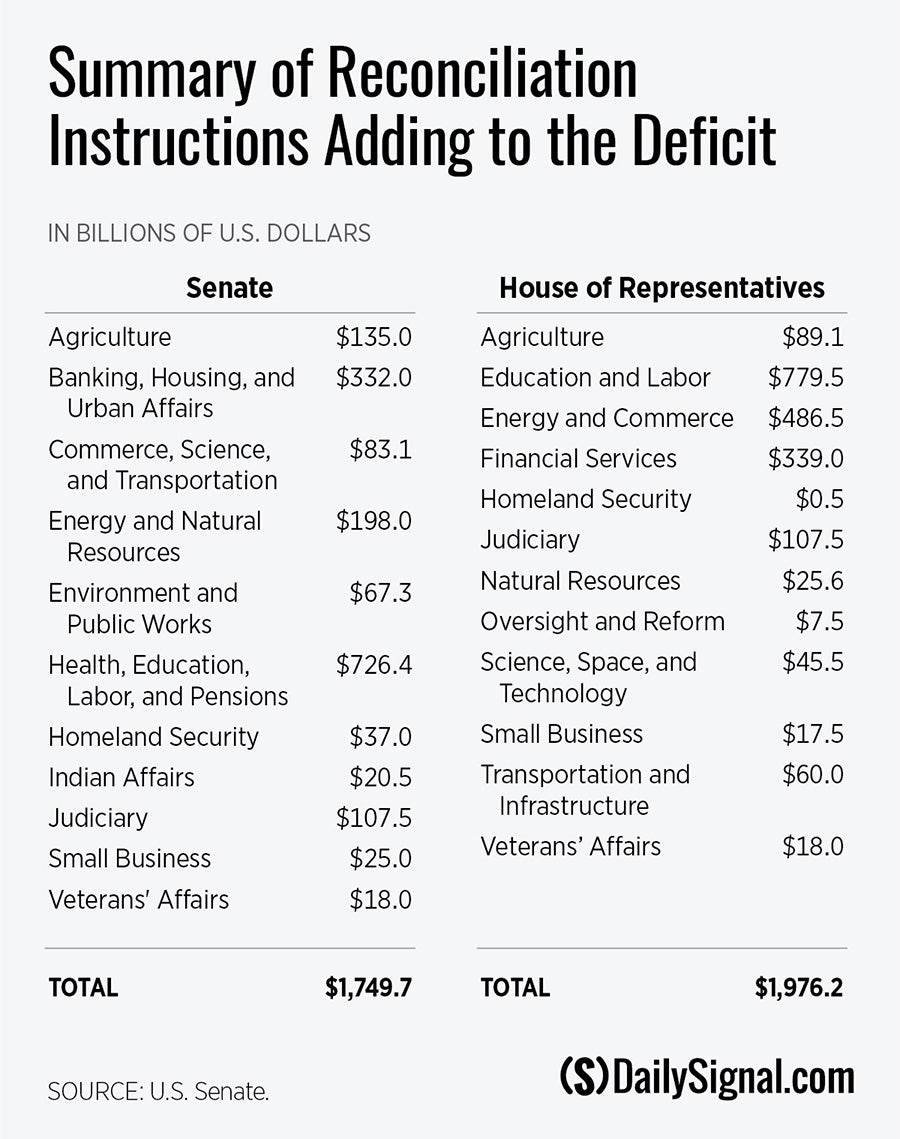
Democrats’ own estimates are that this budget would increase federal spending by more than $4.16 trillion through fiscal year 2031. However, it’s also important to see how much they want to increase spending in just the first year: at least $1.75 trillion.
That is how much the reconciliation instructions would allow them to increase the deficit by. So, just with this single year’s budget, Biden and congressional Democrats would be able to avoid the filibuster to add $1.75 trillion to the deficit.
In truth, with the unlimited ability to raise taxes in this budget, there is no real cap on how much they could spend through reconciliation either.
Further, this budget contains several provisions implying spending on various projects, including infrastructure (read as whatever they define as “infrastructure” today). It should also be noted that the tax code can be utilized to effectively create new spending programs.
4. Path to a Debt Crisis
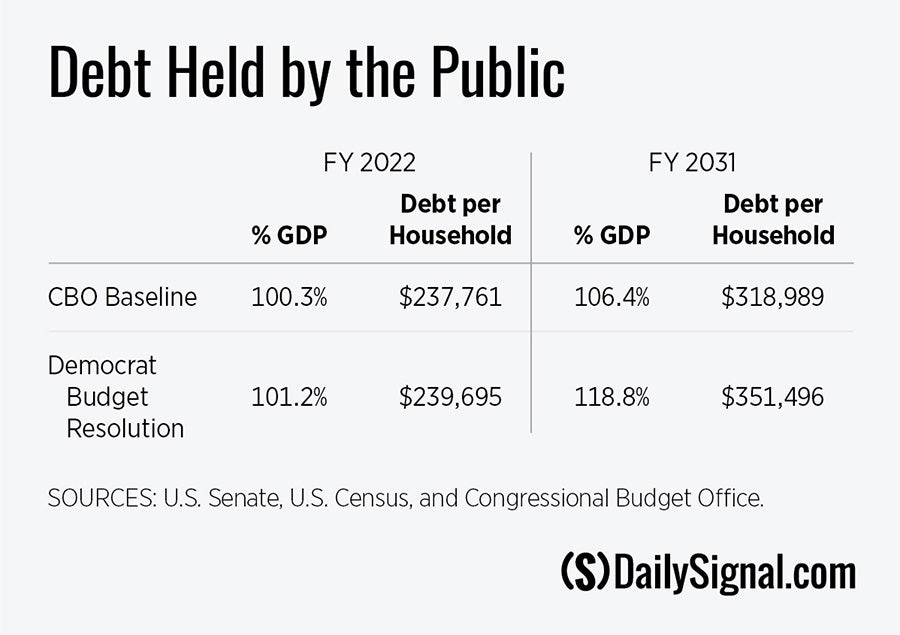
Not only would this plan increase the publicly held debt by more than $4.16 trillion, bringing it to more than 118% of gross domestic product, but it would leave us with well over $2.2 trillion annual deficits by fiscal year 2031. In fact, this plan would envision spending over $1 trillion in fiscal year 2031 just on the net interest for the federal debt.
At a minimum, similar to a tax increase, this new debt would represent the federal government crowding out private investment and stifling wage and job growth. Ultimately, this would set us further down the path toward an unrecoverable debt crisis.
5. Recipe for Inflation
While some of the recent trend of higher inflation is related to the pandemic, it is mostly the result of our reckless federal fiscal policy—which this budget would double down on.
When the federal government increases taxes and crowds out private investment it stifles economic activity. This reduction in real productivity leads to higher rates of inflation as more dollars are chasing fewer goods and services.
To compound this crisis, the Federal Reserve would likely print trillions of more dollars to finance a portion of this deficit spending. In fact, since the start of the pandemic, 54% of the new federal debt ($2.8 trillion) has come from newly printed cash flooded into the economy by the Fed.
The exponentially higher rates of deficit spending, taxation, and money printing that would result from this budget would only serve to exacerbate the current inflationary trend.
6. Breaking Biden’s Infrastructure Promise
During this summer’s negotiations over the bipartisan infrastructure bill, many conservatives warned that any concessions made by Democrats would be undone by using reconciliation to get the rest of what the left wants for urban transit and passenger rail.
To keep Republicans at the negotiating table, Biden said he was willing to give up some of the transportation spending that he wanted, and reserve reconciliation for areas not related to infrastructure, such as social and environmental programs.
The Senate budget resolution breaks this promise by giving $60 billion in reconciliation instructions to the House Transportation and Infrastructure Committee, on top of the $1.1 trillion infrastructure deal.
The summary from the Senate Budget Committee explicitly states that the reconciliation instructions are expected to be used to increase spending on items already covered by the infrastructure bill, including transit improvements, investments in transportation, ports, and clean vehicles.
This shows that months of infrastructure negotiations were done in bad faith.
7. Loopholes and Gimmicks
The point of a budget is to establish responsible fiscal priorities and set up guardrails to assure Congress meets those goals.
However, this budget resolution is filled with loopholes and gimmicks that will make it easier to increase spending.
For the reconciliation bill, the budget resolution waives points of order against increasing the deficit within the budget window and over the long term.
It also includes several reserve funds and adjustment authorities that will allow the chairman of the Budget Committee in the House and Senate to retroactively adjust the levels and allocations in the budget resolution. This is particularly relevant because the budget resolution hides the fact that congressional Democrats are calling for trillions of dollars in tax increases. Instead, those revenue increases will have to be accounted for in the budget later.
The budget resolution also repeals a point of order in the Senate against designating spending as an emergency, which exempts it from the normal budgetary enforcement procedures.
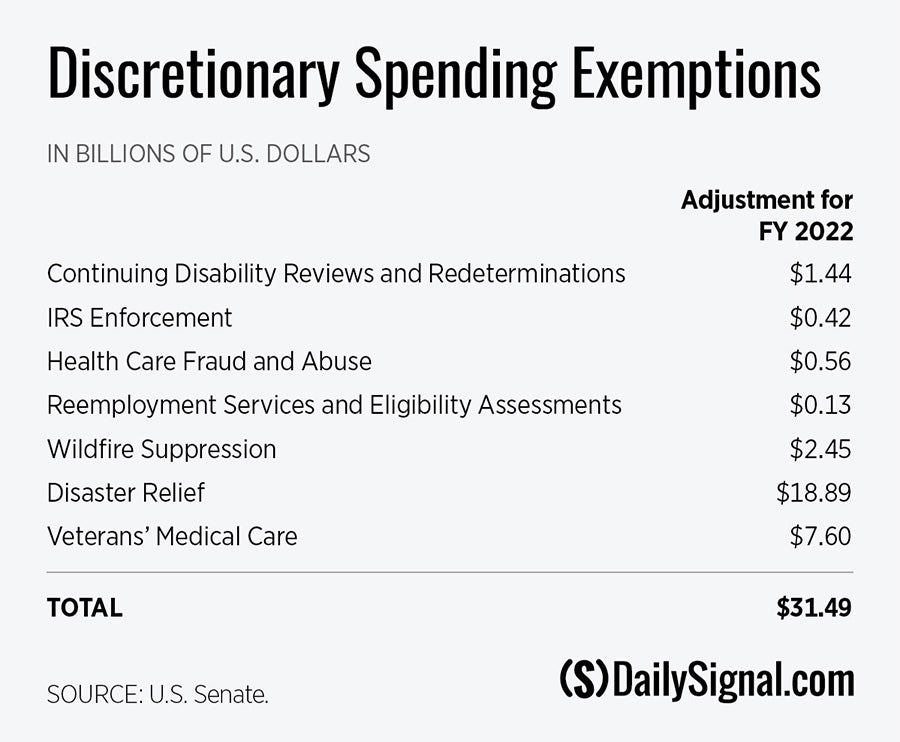
The budget resolution allows the chairman of the Budget Committee to adjust the 302(a) allocation, which sets the overall amount that the Appropriations Committee can spend, if the appropriations bills include funding for certain categories of spending. This adjustment effectively exempts $31.485 billion of spending from the normal discretionary spending levels.
With the expiration of the Budget Control Act caps, these exemptions are no longer necessary, and only serve to weaken the need for Congress to prioritize these categories of spending over low-priority programs.
8. Mistaken Priorities
Despite the trillions in higher spending in this budget resolution, it still manages to shortchange the core constitutional responsibility of national security.
Compared to the Congressional Budget Office’s baseline, this budget resolution would reduce national defense budget authority by $391 billion over the 2022-2031 period. For fiscal year 2022, it does not even match the level marked up by the Senate Armed Services Committee.
9. Fails to Address the Biggest Fiscal Challenges
This budget resolution fails to tackle the nation’s most important fiscal challenges, while likely making future reforms to forestall a crisis even more difficult. Any meaningful fiscal reform must tackle the unsustainable entitlement programs, including Medicare, Medicaid, subsidies for private health insurance, and Social Security.
Without reforms, the Medicare Hospital Insurance Trust Fund will be depleted in 2027 and the Social Security Trust Fund will be depleted in 2032, according to the Congressional Budget Office.
The looming insolvency of the federal government’s two largest programs should be a wake-up call for the need to consider serious changes that would result in better outcomes for those who depend on these programs.
When the Social Security Trust Fund is depleted, it will trigger an immediate 25% benefit reduction, which translates into a low-income earner’s benefit falling by $3,700, to $11,200 per year. Already, Social Security takes 12.4% of workers’ paychecks; keeping it solvent would require a 33% increase in the payroll tax, to 16.5%, or an extra $102,000 in Social Security taxes for an average worker.
Workers shouldn’t have to give up so much of their earnings for a program that’s a terrible deal for most Americans.
By shifting to a smaller, more targeted Social Security program, policymakers could actually help create a significantly larger economy, with higher incomes, greater personal savings, and generations of Americans less dependent on their children and grandchildren.
Congress Must Reject This Budget Resolution
Instead of this budget resolution, Congress should follow a responsible fiscal path that begins to confront the problem of overspending and a federal government that is already too burdensome and unsustainable.
Have an opinion about this article? To sound off, please email letters@DailySignal.com and we’ll consider publishing your edited remarks in our regular “We Hear You” feature. Remember to include the URL or headline of the article plus your name and town and/or state.