Jesus Said What?
 ATTENTION: Major social media outlets are finding ways to block the conservative/evangelical viewpoint. Click here for daily electronic delivery of The Stand’s Daily Digest – the day’s top blogs from AFA.
 DR. RAY ROONEY, JR.DIGITAL MEDIA EDITORMORE“Why don’t Christians keep their antiquated views and opinions in their churches and to themselves? They should let people live out their lives the way they want. They’re just interfering bigoted hate mongers!”
Those and other charges have been bandied about by political and religious progressives so much that some rather large segments of the church have succumbed to the endless badgering. Most keep quiet outside the church and many have even joined the progressives. Why and how has this happened?
The sexual revolution of the sixties and seventies coupled with the rebellion against authority spread into colleges and universities giving it much-needed legitimacy. It trickled into our churches where it was initially rebuffed but over time has finally established a stronghold. Biblical accuracy slowly but surely began to take a back seat to cultural accommodation. Ripped from their proper context passages like John 3:16 and 1 John 4:16 seemed a nice fit as a ‘love at all costs’ message.
However, reading the Gospels as they were written and intended to be understood, will not allow one to embrace a go-along-to-get-along feel-good privatized version of Christianity. Take, for instance, the gospel of Matthew.
Matthew was written very close in time to the Roman siege of Jerusalem and the destruction of the temple (which was, of course, the focal point of Jewish faith and religion and continued to be important to the first followers of Christ). That event was going to be felt by the Jews for millennia. To this day, there is no Jewish temple in Israel.
What kind of language do you use if you know that a tragically seminal event is very near? Words not only communicate ideas, but they also paint mental images.
Matthew has Jesus saying things (consistently) that if put on film would warrant an R rating for graphic violence. And if the average churchgoer has heard them, they are quickly dismissed from thought because they don’t fit the narrative that Jesus was nice and vigilantly mindful of the sensitivities of others.
For instance, in the Sermon on the Mount (of all places) Matthew relates that when Jesus got to the subject of adultery He suddenly said,
If your right eye causes you to sin, tear it out and throw it away…and if your right hand causes you to sin, cut it off and throw it away…(Matthew 5:29-30).
Words intentionally convey images and neither of those is a pretty one. Like I said, R rated if you put it on film.
Interestingly, Matthew says Jesus reiterated virtually the same thing again in chapter 18 verses 8-9. Again, it is the Lord’s advice for those who feel they may yield to the temptation to sin. Cut off your hand or foot rather than yield and tear out your eye if you can’t stop looking where you shouldn’t. He may be speaking metaphorically but still, the mental images are gruesome.
Oh, but it doesn’t end there. In Matthew 21:44 Jesus speaks of those who fall on the cornerstone as being crushed and broken in pieces. Like that image? There are others. In the parable of the wedding feast, He said the man who was at the wedding but not dressed in the appropriate clothing would be tied up and thrown into “outer darkness” (Matthew 22:13). The implication is that being bound and thrown in the darkness will be a permanent situation. Have you ever read Poe’s The Pit and the Pendulum or seen a movie with a buried alive scene? Very uncomfortable. In Matthew 23:27 He said the scribes and Pharisees were like tombs filled with dead people’s bones “and all uncleanness.” Death, graves, decay, worms, etc.
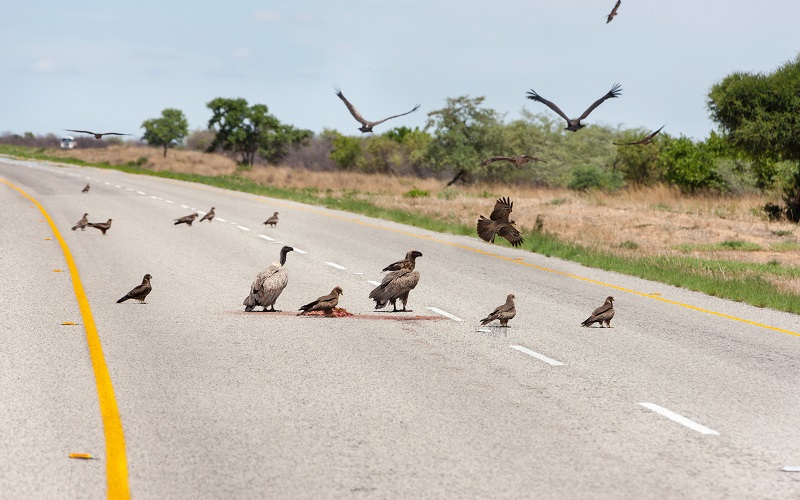
In the middle of the discourse concerning the end times, Jesus likened the cultural and spiritual climate to vultures feeding on a corpse (Matthew 24:28). We’ve all seen that ugly scene driving down a country road with roadkill in the middle of the lane. Nasty.
Again, in the same discourse, He likens those who fail to prepare themselves for His coming to drunkards who will be cut into pieces and put with the hypocrites where “there will be weeping and gnashing of teeth” (Matthew 24:45-51). “Cut into pieces”? Really? Why was it necessary to put that image in my mind?
Finally, at the Last Supper, Matthew reports that Jesus lifted up bread and wine and said, “Take, eat, this is my body” and “drink of it, all of you, for this is my blood of the covenant, which is poured out…” (Matthew 26:26-28).
Words paint pictures and many of the words that Jesus Christ spoke painted pictures that are far removed from flowers, beaches, or castles in the sky. Rather, there were images of dismemberment, open graves, being crushed, cut into pieces, solitary confinement, and even cannibalism.
If you are shocked at this I hope you grab your Bible and turn to the gospel of Matthew. I used the English Standard Version but you will be hard-pressed to find any version that cleans up all those terrible images created by the words of Christ.
Why such terrible imagery by the Prince of Peace? Remember, Matthew is writing very near to the worst catastrophe to fall on Israel in all its storied history. They had recovered from four centuries of slavery in Egypt. They survived the divided kingdom. They even rebounded from the Babylonian Captivity. But to this day, Israel has yet to fully recover from the havoc that Rome wrought in 70 A.D.
My point is that Matthew’s Jesus used the kind of imagery to match what was at stake. What led to the disaster of the razing of the temple was the kind of religious belief and practice advocated by the religious leaders of Israel embodied by the Scribes and Pharisees. When Jesus tried to speak in a more palatable and acceptable language the message shot straight over the heads of the audience (Nicodemus: “How can a man be born when he is old? Can he enter a second time into his mother’s womb…?” and “How can these things be?” John 3:4; 9).
John’s gospel focuses on belief but Matthew presents the ministry of crisis. The horror of 70 A.D. required a language that called for horrific imagery because of the implications.
So, back we go to the opening accusations against today’s faithful Christian. “Why can’t you just let people live their lives the way they want?”
Because of what is at stake.
Read Matthew 23:15 for some enlightenment. People have been sold a bill of goods that just isn’t true. They have been deceived by forces that want to manipulate their decisions and control their destinies just like the Scribes and Pharisees of old. They talk “freedom” when the reality is “bondage” and the consequence is destruction. Faithful Christians aren’t willing to sit back and enjoy the show (like Jonah wanted to do) as those who have been blinded head straight for the ditch from which there is no recovery.
I’m sure Jesus would have preferred to use language and imagery that painted a Disneyesque picture of the world. But He wasn’t facing Walt Disney’s world. He was facing more of a Quentin Tarantino world. A world of hypocrisy where there is supposedly no eternal consequence for self-gratification and self-indulgence. To that world, Jesus brought terrifying and graphic images of what the consequences of continued disobedience to God would be.
That is still the world we live in. And the signs of massive upheaval are everywhere. Do followers of Christ just sit back and enjoy the show? I think not.


















The Disaster at Our Southern Border
The following is adapted from a speech delivered on July 22, 2021, at Hillsdale College’s Allan P. Kirby, Jr. Center for Constitutional Studies and Citizenship in Washington, D.C., as part of the AWC Family Foundation Lecture Series.
In just a few short months, the Biden administration has created a disaster on the southern border of the United States. It did so by methodically—and by all indications intentionally—undoing every meaningful border security measure that had been in place. As a result, we have had five straight months of over 170,000 illegal immigrants apprehended at the border. The number in June was the highest in over 20 years. And Immigration and Customs Enforcement (ICE) has been effectively shut down.
Our national discussion of border security is generally misleading, and it is designed to be misleading by those who favor open borders. They frame the issue as if the American people face a binary choice: either let all immigrants in because they are “looking for a better life” or close our borders completely and inhumanely. But this is a false choice. The unspoken alternative is to enforce the law, taking in immigrants who enter the U.S. legally while securing our borders against those who attempt to enter illegally—particularly those meaning to do us harm.
Illegal immigration is, of course, nothing new. It has been a problem in our country for many decades. What is relatively new is the total lack of concern we see in the Biden administration, especially in terms of the national security aspect of border control.
Unbelievable as it may seem to us today, it was only 15 years ago—with the 9/11 terrorist attacks still fresh in our minds—when Congress came together in a bipartisan effort to pass the Secure Fence Act of 2006. The Secure Fence Act directed the Department of Homeland Security to take appropriate actions to achieve “operational control” over U.S. land and maritime borders to “prevent unlawful entry.” It defined operational control as the prevention of all unlawful entries into the U.S., including terrorists, instruments of terrorism, narcotics, and other contraband. And it specifically set the goal of “provid[ing] at least two layers of reinforced fencing, installation of additional physical barriers, roads, lighting, cameras, and sensors.” It added thousands of Border Patrol personnel, mandated the acquisition of new technologies, and resulted in the construction of more than 650 miles of physical barrier along the southern border of the U.S. between 2006 and 2011.
To repeat, this legislation was passed in a bipartisan spirit, with 80 members of the U.S. Senate voting to approve it. This included Senator Barack Obama, who said in 2005: “We simply cannot allow people to pour into the United States undetected, undocumented, unchecked, and circumventing the line of people who are waiting patiently, diligently, and lawfully to become immigrants in this country.” It included Senator Chuck Schumer, who said in 2009: “Illegal immigration is wrong, plain and simple. . . . People who enter the United States without permission are illegal aliens and illegal aliens should not be treated the same as people who enter the U.S. legally.” And it included Senator Joe Biden, who said in 2006: “Let me tell you something, folks, people are driving across that border with tons, tons—hear me, tons—of everything from byproducts from methamphetamine to cocaine to heroin, and it’s all coming up through corrupt Mexico.”
Some attribute the breakdown of the bipartisan consensus on securing the border to the fact that Democrats came to look on illegal immigrants as much-needed Democrat voters. For whatever reason, a decade later these same Democratic leaders were lambasting President Trump’s border wall policy as “immoral and ineffective,” even “racist,” and fiercely opposing any and every serious proposal aimed at enforcing immigration law.
***
When I say that the Biden administration methodically undid every meaningful border security policy that it inherited, what specifically do I mean? I’ve mentioned the border wall. And it is a demonstrable fact that border walls, placed in strategic locations, act as effective impediments and improve the ability of law enforcement to drive and dictate the behavior of criminal organizations rather than being driven and dictated to themselves. One of the most ridiculous criticisms I’ve heard is that the wall is “a fourteenth century solution for a twenty-first century problem.” The same could be said of the wheel, which also still works pretty well.
In any case, the first bullet point of President Biden’s budget for the Department of Homeland Security this year trumpets the fact that not a cent will go towards the construction of border walls.
Yet despite the amount of intense debate the border wall engendered, it was not the only or even the most important border security measure instituted under the Trump administration. Let me outline two other key game changers.
Prior to Trump’s presidency, a combination of three things had the effect of forcing the Department of Homeland Security to institute a “catch and release” policy for illegal immigrants: the Trafficking Victims Protection Reauthorization Act of 2008, which mandated that the U.S. detain all unaccompanied minors from non-contiguous countries (countries other than Mexico and Canada); Deferred Action for Childhood Arrivals, an executive policy adopted in 2012 to allow some of the migrants brought into the country illegally as children to receive a renewable deferred action from deportation; and the Flores Settlement Agreement, a 1997 court decree that was reinterpreted in 2015 to prevent the U.S. from detaining migrant families and unaccompanied minors for more than 20 days. In addition to catch and release, these things combined to bring about a demographic shift in illegal immigration that was immediately exploited by smuggling organizations—a shift from the influx of predominantly single adult males from Mexico to an explosive influx of families and unaccompanied minors from far and wide, and particularly from Central America. By 2016, the message had been sent and received that America’s southern border was wide open.
In response to this, the Trump administration negotiated the Migrant Protection Protocol, a bilateral agreement with Mexico more commonly known as the Remain in Mexico Program. Under this agreement, people illegally entering or being smuggled into the U.S. with a minor would no longer be able to stay simply by asking for asylum. It was chiefly this Remain in Mexico Program that ended catch and release, removing the greatest incentive for people to try to enter the U.S. illegally.
Prior to the full implementation of the Remain in Mexico Program—at the height of the 2019 border crisis when Department of Homeland Security facilities were overwhelmed—the Flores Settlement Agreement had forced Border Patrol to release illegal alien families, often just hours after they were apprehended. In May of that year, Customs and Border Protection were apprehending over 5,000 illegals per day. After full implementation of Remain in Mexico, illegals who applied for asylum were returned to Mexico to await their hearings. This resulted in a dramatic reduction in the flow of illegal immigrants, especially of families and unaccompanied minors. By February 2020, we had seen a 75 percent reduction in families attempting to enter illegally. Many chose to return home—either on their own or with the assistance of the Mexican government—since catch and release was no longer in effect. It was a big victory for the rule of law.
The current out-of-control surge at the border stems chiefly from the fact that the Biden administration acted quickly to halt the Remain in Mexico Program and return to catch and release. In response to a lawsuit brought by the Texas Attorney General, a federal judge has recently ruled that Remain in Mexico must be reinstated, and the U.S. Supreme Court has refused to overturn that ruling. How this will play out remains to be seen.
Another game-changing development under the Trump administration was a series of Asylum Cooperative Agreements made between the U.S. and the Central American countries of Guatemala, Honduras, and El Salvador. These Asylum Cooperative Agreements codified accepted international practices governing asylum seekers, which encourage migrants to seek relief from the first safe country able to assist them. Migrants from these countries seeking asylum in the U.S. were traversing thousands of miles, across multiple countries, and our policies were encouraging that. The Agreements not only encouraged migrants to obtain immediate assistance closer to home, they also served as a deterrent to those with fraudulent claims.
Less than three weeks after President Biden took office, Secretary of State Antony Blinken announced that “in line with the President’s vision” the U.S. had suspended, and was in the process of terminating, the Asylum Cooperative Agreements with Guatemala, Honduras, and El Salvador. In the same announcement, Blinken said that the new U.S. approach to the problem of migration from these countries would be to address the “root causes” of that migration—especially economic underdevelopment and poverty, although, oddly enough, climate change has been mentioned as a root cause as well.
We are hearing more and more subsequently about root causes—especially from Vice President Harris, who President Biden charged with developing a “Root Causes Strategy.” But what we are hearing is bunk. The fact is that when the U.S. opens its borders—which is what it amounts to when we return to a catch and release policy—illegal immigrants flock to the U.S. That’s the root cause of the crisis on our southern border. Compare the numbers in April of last year to those of this April: there was a 900 percent increase in illegal immigration. The economic conditions in Central America didn’t markedly change during that period. The climate didn’t markedly change. Our policies changed! That’s the root cause.
There is a second important point to make in this regard. The basic legal premise of asylum is that the migrant must have a valid claim to be the victim of persecution in his or her home country due to race, religion, nationality, political affiliation, or membership in a protected class. Under current law, a desire to improve one’s economic status is not a valid asylum claim. If it were, the overwhelming majority of people in the world would have a valid claim to seek asylum here. Open borders advocates, including those in the Biden administration who harp on root causes, cultivate the myth that a desire for economic betterment is a valid reason by itself to seek asylum. That would require a radical change in U.S. law that I don’t think the American people would accept.
***
The incoming Biden team received exhaustive briefings on the situation at the border and was warned about the consequences of undoing the security policies they inherited. They were told clearly that Border Patrol stations didn’t have adequate capacity to handle the surge of illegal immigrants that would follow a reversal of policy; they were told clearly that the Department of Health and Human Services did not have the detention capacity to handle it. They were told that smuggling organizations and other criminal groups would exploit a return to catch and release.
Despite this, they rushed to dismantle the entire system. And with the results becoming evident to the public, they resorted to deception. I’ve served in federal law enforcement in various capacities for more than 35 years, under six different administrations. And while I’ve become numb to the spin and misdirection that is commonplace in Washington, I have never seen as blatant a disinformation campaign as this one.
Initially, this campaign involved outright denial: “Our message has been straightforward—the border is closed,” said Secretary of Homeland Security Alejandro Mayorkas on March 21, in the midst of a surge across the border of families and unaccompanied minors. There was also deflection: Mayorkas blamed the surge on the Trump administration, which he claimed had “torn down” the “entire [immigration] system” that had been in place. This took a lot of gall, given that the surge was so obviously a direct response to the termination of Trump’s Remain in Mexico Program and Asylum Cooperative Agreements and the revival of catch and release.
We were also treated to a fictitious narrative according to which the surge was the reflection of seasonal trends. A “significant increase” in migration “happens every year” in the winter months, President Biden claimed at his first presidential press conference, since that is when migrants “can travel with the least likelihood of dying on the way.” The problem is that this year’s winter numbers dwarfed those of 2020—not to mention the fact that the surge has continued unabated into the spring and summer. The June apprehension number exceeded 180,000, and in July it exceeded 210,000. Year-to-date apprehensions are over one million, including more than 100,000 unaccompanied minors—a 444 percent year-to-year increase.
At the point when the administration could no longer deny the dangerously overcrowded conditions at Border Patrol facilities, some operating at more than 400 percent capacity, it adopted a shell game strategy, first moving migrants into newly-constructed facilities and then surreptitiously flying families and unaccompanied minors to cities throughout the U.S. The point of this ongoing shell game is not to stem the flow of illegal immigrants into our country, but to improve the political “optics” of the crisis.
***
Make no mistake, criminal organizations—which are adept at exploiting weak and ambiguous U.S. immigration policies—are paying close attention to what’s happening and will adapt their tactics and procedures accordingly. The commonsense reality is that by incentivizing and facilitating illegal immigration, the Biden administration is making it easier for drugs to pour into the U.S., for human trafficking to expand, and for criminal aliens to infiltrate our society. Simply consider that between 40 and 50 percent of Border Patrol and other Customs and Border Protection enforcement resources have been pulled off the front lines to provide humanitarian aid, leaving large areas of the border unmonitored and unsecured.
It is estimated that the number of “got aways”—not the illegal immigrants being relocated around the country, but those who have successfully entered undetected—already surpasses 260,000, more than the population of the city of Arlington, Virginia. And we can safely assume that not all of them are good upstanding people.
In the past decade, the Border Patrol has apprehended tens of thousands of criminal aliens and gang members. It is estimated that just this year, the Border Patrol has apprehended 8,000 criminal aliens—including 46 murderers, 393 sex offenders, and 880 assailants. Over the July 4 weekend, it apprehended several members of MS-13, the most violent transnational gang operating in the U.S. It also recently apprehended two Yemeni nationals who were listed on the U.S. Terrorist Screening Database. In 2020, ICE made more than 100,000 arrests, with 90 percent of those arrested having a criminal conviction or pending criminal charges.
In addition to utilizing illegal immigration as a distraction technique, smuggling organizations often force migrants to carry drugs across the border as a means of payment. And they use their profits from human smuggling activities to finance increasingly more sophisticated drug smuggling techniques that involve tunnels, drones, ultra-light aircraft, and maritime operations. So far this year, Customs and Border Protection assets have participated in the seizure of more than 600,000 pounds of drugs. Fentanyl seizures have skyrocketed in 2021, with more than 6,000 pounds being seized by Border Patrol and Customs and Border Protection—a 300 percent increase over this time last year.
Let me end by saying something about what is bureaucratically called the 287(g) program—it is called that because it was established in Section 287(g) of the Immigration and Nationality Act in 1996. This is the program that makes it possible for local law enforcement to work with ICE in removing illegal criminal aliens. A majority of Americans oppose the idea of so-called sanctuary cities, which are disastrous in terms of public safety. What they might not realize is that every city is now threatened with becoming a sanctuary city. Why? Because the Biden administration has effectively shut down ICE. So today, for instance, a sheriff’s department can arrest a known gang member who is in the U.S. illegally for a non-violent felony such as burglary or drunk driving. But if that sheriff calls ICE, he will be told that is not a priority and that he should release the criminal gang member back into the community.
Thomas Feeley—until recently the director of ICE in New York State—resigned from ICE out of frustration that the Biden administration is, in his words, “doing everything [it] can to cripple [enforcement and removal operations].” In an interview following his resignation, Feeley related an incident where he was told to release an illegal immigrant who was a convicted arsonist. The rationale for releasing the illegal was that he hadn’t been arrested in the past ten years. He hadn’t been arrested, Feeley pointed out, because he had been in prison during that period. But that didn’t matter. He was released into the community anyway.
***
In conclusion, it is simply common sense to view border security as national security. If you make this point today, you risk being called a racist or worse. But it needs to be said over and over until we fight our way back to the point where we have a bipartisan consensus that immigration laws should be enforced. This is not going to be easy. Even as the acting commissioner of Customs and Border Protection, I had my official government Twitter account blocked prior to the 2020 election for posting a photograph of the border wall and explaining that it is an integral part of effective border security. The powers-that-be eventually reversed this decision, but it is an indication of what the American people—who overwhelmingly support border security—are up against.
What we need is widespread active public involvement. Illegal immigration, border security, the erosion of the rule of law, and the loss of our nation’s sovereignty are interconnected, and should be debated as important issues in local and state politics as well as national. When I was the chief of U.S. Border Patrol in the Obama administration, Secretary of Homeland Security Jeh Johnson told us that 1,000 illegal immigrants a day is a bad day. Today that number is approaching 7,000, and nothing is being done about it. This can’t be allowed to continue. A country that cannot control its borders is not a country, and I’m sad to say that we are facing that eventuality.
|
||||||||||||||||||||||||
|
||||||||||||||||||||||||
|
||||||||||||||||||||||||